Tag: life

  • Philadelphia

    Philadelphia

    Philadelphia is a city where the dwellers seem gripped by a recurring sense of having lived the exact moment before. The same conversation, the same person with a smirk on his face, the same weather — precisely when your neighbor locked his apartment to leave and the mayor was having a nightmare about his house being bugged by the FBI. Or you might hear the jumbled voices on the radio discussing Dalí and the death of a jazz singer in your car while a Black man walked across the street with a beer bottle in hand.

    It’s a city that has been aging ever since Ben Franklin dreamed that, on the day of his funeral, leaders — thirty-four ministers, preachers, priests, and at least one rabbi — marched arm in arm behind his casket as it was carried to the gravesite. He even dreamed of the Liberty Bell crumbling.

    If you sit in one of the chairs in the old assembly hall of the Constitution House, after climbing the sturdy wooden stairs, you could still sense the rustle of tunics and sombreros worn by your fellow legislators. Perhaps you could still argue with them to make Gujarat the fifty-first federal state.

    If you walk through Center City along the sun-soaked brick buildings, you might meet travelers from neighboring towns afflicted by bouts of insomnia, lost in the constitutional walking tour of Philadelphia. And if you drift down toward the inner city along the Delaware River, you might find Lila, the aging and desperate wharf-bar pickup, and hone your ruminations on life and civilization into something understandable and real before you sail back out to the outer seas again.

    Further north, you might find Mr. George Tharakan stepping out of his Mercedes-Benz in a suit, entering his four-bedroom house, then later emerging in a lungi to inspect the fence he shares with his fellow native. If you glanced through his family album, you would find him wearing the exact same lungi, inspecting his fence on a similar sunny evening in Thiruvalla, Kerala.

  • Up and Onward, Jemimah

    Up and Onward, Jemimah

    Jemimah hit a hundred chasing a mammoth score, with tough-as-nails women from Australia standing between her and victory. She did not raise her bat to soak in the glory. She knew the fight was far from over, and her team had folded a few times already in the tournament with the finish line in sight.

    She became the cheerleader for her tiring self, her team, and a nation that barely rallies behind its daughters. She had spent almost the entire game from the start in the hot and humid cauldron. The steely look in her eyes, the muttering to herself, and the chatter with her mates falling midway in the fight played out before thousands of compatriots. Yet she found an ounce of energy for a few more hits, as if she were riding the crescendo of a symphony.

    The symphony was made of human frailties. Losing to three of the SENA teams in the lead-up to this game had sullied expectations for this side. Their bowling barely inspired confidence. Fielding was in disarray—dropping simple catches, conceding overthrows, stumbling over balls hit straight to fielders. Jemimah herself had failed and been dropped from the team a few times already, and she didn’t even know she was one down until five minutes before she was sent out.

    Her captain and the oldest player in the team, Harmanpreet, was a complex soul trying to break the karmic cycles of those who walked ahead of her out of the park and toward an assured oblivion.. She carries a tortured look, as if fighting a demon that never lets her be. She, too, was cramping, but decided to lash out, believing Jemimah would anchor the ship still teetering in the tempest with a prayer. The match could very well have been her last had India lost. But the partnership with Jemimah became their ticket to redemption. Other batters brought much-needed wind to the sails, even as they faltered along the way.

    There is no video of Kapil Dev’s 175 against Zimbabwe, when the World Cup-winning team was on the brink of elimination. But that team of 1983 changed the destiny of Indian cricket and the spirit of a nation. Yet it was still a man’s victory.

    Women’s team coach Amol Muzumdar, too, has his tryst with destiny. He never got the chance to wear the blue, waiting in the shadows through a long career despite being one of domestic cricket’s greatest run machines. He started his career waiting for a chance to play for India, padded up and waited for an eternity and a day, while Tendulkar and Kambli batted to glory.This was his Chak De moment—seeking redemption alongside the girls who know what it means to be so near, yet so far.

    But this is Jemi’s time—to change the destiny of millions of girls and help them chart their own course to the future.

    It is already late.

    Photo Credit: Emmanual Yogini

  • A house in dreams

    A house in dreams

    Every member of the family carried a house within them—a dream shaped by their longings, fears, and memories. Though they spoke of walls, windows, and rooms, each vision revealed not bricks and wood but the architecture of their own hearts.

    The father, who had already traveled a million miles, thought about the house he was going to build:

    The house is where I would find my moorings at the end of a hard day. At night, it takes the form of a ship anchored at the wharf, leaning into the widening shimmer of the ocean. The balmy breeze across the yard would unfurl the sails and carry us a few more knots.

    I want the entrance to rise into a cathedral ceiling, with glass windows all around and a den in front where I can watch storms and lightning pass by. The dwellers of my Ark would hold onto one another until morning breaks—and then I can let them fly into the bluest sky. Perhaps I need a longer glass to see far enough.

    Shrugging off the captain’s apprehensions, the daughter dreamed instead:

    My house begins in the attic, where I have a bird’s-eye view of the landscape beyond the fence, where I can listen to rain rattling on the roof and feel the moist nights tick away as water drips from the drain. Then the sunshine flutters its mosaic across the slanted windows. I want to walk down the stairs into the living room where the family gathers. This house of my dreams is grand and old, and I sense a déjà vu—of being transported to a timeless time.

    The son, impatient with his sister’s hopeful reverie, thought to himself:

    The idea of a basement comes from human fear of death and an expectation that bad things will happen. A dingy crawl space would be preferable. To me, the house feels like a mausoleum built upon such a basement. I know the trusses and walls will crumble someday, and there will be an onslaught of dust until everyone inside turns ghostly. The laughter, sobs, and voices trapped in the air will die a natural death, and I will want to go far away. I would erase every trace of my footprints, too.

    The mother, who packed their belongings from rented apartments time and again, always returned to her own dream:

    This house is a refuge, a boundary drawn against the melancholy of the world. A shelter for the displaced and broken human spirit to restore body, mind, and soul. There should be a dining area beside the living room, ready to welcome and nourish those who come home battered and bruised. And in the bedrooms, soft light will heal them.

    post script:

    Together, their dreams did not form a single blueprint but a constellation of desires—an ark, an attic, a mausoleum, a refuge. The house in their dreams was never just a dwelling; it was the story of who they were, and who they hoped to be.

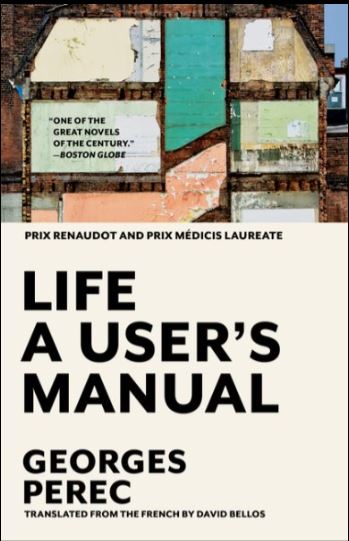
  • Life A User’s Manual

    Life A User’s Manual

    I read Georges Perec’s Life: A User’s Manual when I was a master’s student in physics. At the time, I was toiling through books and lectures on classical and quantum mechanics—essentially, working for a degree. The Lagrangian and Hamiltonian equations, particle theories, their graduation to quantum physics, and further into Schrödinger and Heisenberg’s formulations, all passed by in a haze.

    I was grappling with the concept of constraints in Lagrangian mechanics when I opened Perec’s preface. In it, he forewarned the reader about the games and devices he had woven into his novel. Although he wrote the book to be eminently readable, he made no bones about the underlying rigor of its construction: the sequence of chapters follows the algorithm of a chess game; jigsaw puzzles, crosswords, and probabilistic formulas organize the literary elements—objects, characters, situations, allusions, and quotations—into a deliberate order; even the indexing of its ninety-nine chapters is modeled after Dewey. It was the mind of an architect at work—focused, meticulous, and simultaneously non-committal about the grandeur of the project, stoic about its futility, and dispassionately observant of life’s intricate goings-on.

    Lagrange essentially said that imposing constraints on a system is another way of stating that forces are present in the problem which cannot be specified directly, but whose effects on motion are known. Perec took this principle into literature—adopting constraints as an empirical approach to writing and, by extension, to reading.

    Perec was part of the Ouvroir de Littérature Potentielle (Oulipo) group, devoted to the study and invention of literary forms. Under the leadership of Raymond Queneau and François Le Lionnais, the Oulipo worked—and still works—to identify and revive neglected forms, while also devising new ones based on rigorous formal constraints. One member famously defined the group, tongue firmly in cheek: “Oulipians: Rats who must build the labyrinth from which they propose to escape.” Perec found a home here, among writers like Jacques Roubaud, Harry Mathews, Italo Calvino, and Marcel Bénabou.

    Life: A User’s Manual tells the story of a ten-story building at the fictional 11, rue Simon-Crubellier in Paris, meticulously describing its interior and the lives of its residents—179 stories in all. Their order is determined by a famous chess problem: visiting every square on a board using only the knight’s move. Once the constraints are set, Perec emerges as anything but a cold formalist—his affection for the characters and their idiosyncrasies is unmistakable. The stories stir wonder, laughter, and reflection, as they reinvent genres—romance, drama, detective tale, adventure, murder mystery—through restaurateurs, mediums, cyclists, antique dealers, and pious widows.

    Some examples:
    – A trapeze artist’s swansong at the circus—an impossible feat that ends in his death.
    – An archaeologist on the Nile trying to rescue a German girl from a harem.
    – A judge’s wife whose thrilling thefts lead to hard labor, ending as a bag lady on a park bench.
    – A murder mystery in which the protagonist adopts the Monte Carlo theory of probability to find his wife’s and daughter’s killer—only to narrowly miss encountering him.
    – A prophecy that shadows generations of a tragedy-stricken family, glimpsed only in a brief visit to an empty apartment.

    These stories leave little doubt about Perec’s storytelling gift. Beneath them all runs a subtle negotiation between writer and reader, with the big picture always in the backdrop. That is where Perec introduces his central figures: Bartlebooth, the millionaire maverick painter; Gaspard Winckler, his assistant; and Valène, the concierge who narrates this intricate web of stories.

    Bartlebooth’s project is monumental: over twenty years, he will travel the world painting 500 watercolors of different harbors. Every other week, a painting is sent to Winckler, who mounts it on wood and cuts it into a 750-piece jigsaw puzzle. Once Bartlebooth returns, he will spend another twenty years reassembling the puzzles, then return each to its original harbor, where it will be washed clean, leaving a blank sheet—the beginning and end coinciding. But things do not go as planned.

    To avenge twenty years of “pointless” work, Winckler begins making the puzzles increasingly difficult. Almost blind, Bartlebooth dies while attempting the 439th puzzle. Perec’s final paragraph captures the irony:

    “It is the twenty-third of June nineteen seventy-five, and it is eight o’clock in the evening. Seated at his jigsaw puzzle, Bartlebooth has just died. On the tablecloth, somewhere in the crepuscular sky of the four hundred and thirty-ninth puzzle, the black hole of the sole piece not yet filled in has the almost perfect shape of an X. But the ironic thing, which could have been foreseen long ago, is that the piece the dead man holds between his fingers is shaped like a W.”

    Winckler, dead two years earlier, has triumphed—but it is a meaningless triumph.

    In a single paragraph, Perec captures the grand project of life, the inherent meaninglessness of human effort, and the role of chance in undoing even the most carefully designed schemes. Our lives are shaped by innumerable constraints—social, ethical, moral, physical, biological—some accepted, some resisted—while the interplay of chaos and order goes mostly unnoticed.

    For someone who once wrote a novel entirely without the letter e, and as a leading figure of the Oulipo movement, this feels like a summit. In it, you sense the shadow of Joyce, Borges, Calvino, Flaubert, and Kafka—but also something uniquely Perec’s own.

    For now, I have nothing more to say. Go read it—the book belongs to you, my dear reader.

  • Hope Springs Eternal

    Hope Springs Eternal

    My aunt’s husband left the city of Kochi (Kerala, India) after retiring as a Deputy Revenue Officer. He relocated his wife, and children, except for the oldest daughter finishing college, to Chelakkara in the early seventies, a sparsely populated boondock northwest of Thrissur. After a day-long journey by bus, I had to walk for miles on a rough, winding road flanked by undulating paddy fields on either side until it became an unpaved but equally wide rugged rural pathway, leading to the gate bearing their family name inscribed.

    The house stood in the middle of several acres of land with a bamboo fence. The yard was filled with various fruit trees – many mangoes, jackfruit, guava, gooseberry, cashew apples, and Sapodillas. I was told my uncle even attempted farming paddy once. The original owner of the land was his neighbor. The house also had a cavernous well with nothing but rock at the bottom which my cousin wistfully described as a money pit where his father threw away a fortune over several years hoping for a spring. Now it was just a reservoir for rainwater that dries up in the summer for snakes to snuggle in the damp and shade.

    The house was spacious with a room full of antique cupboards where I found a treasure of his collection of books and audio cassettes. In a chest, I found an official invitation to the first show in Shenoy’s theater in Kochi for its grand opening which someone kept as a souvenir. Uncle had diaries with quotations from and annotations on Malayalam poets, mostly by G. Shankara Kuruppu and Vallathol. It also had notes and tips on farming. I realized the books on Physics and World literature belonged to his brother who died young when he was a lecturer at Brennen College. The complete collection of Yesudas’s Hindi Songs too was his legacy. I never met him. I saw my uncle only twice, of which the second meeting was when I traveled for almost all day in several buses with my parents for his funeral. He visited us a few months earlier to seek my parent’s help to dissuade his younger son from marrying a young girl he met near the dorm, having decided to drop out of college.

    I observed none of my cousins were interested in the books or farming. No one else studied beyond High school or basic trade school while their cousins in Kochi were known for academic excellence including post-doctoral degrees. The older daughter got a job in Government, married, and continued to live in Kochi. They sold the property by the end of 1999 back to the neighbor for a price. Until her last, my Aunt, who retired as a teacher ages ago, lived with the younger son who became a primary school teacher in a small town closer to Kochi. He divorced his first love and is separated from second wife. The other children too found their place now closer to Kochi even though they are still a few hours away.

    I remember watching a French film starring Gerard Depardieu – Jean De Florette (1986). Depardieu played the character of Jean, the Tax Collector and son of Florette who returns with his wife and daughter to the village to claim the land he inherited from his mother to begin the life of a farmer. Ugolin, his neighbor and local farmer who fought with Jean’s uncle earlier for not selling the land, realized that Jean too did not intend to sell. Despite all the efforts to make Jean’s life hell, Ugolin couldn’t make Jean sell his house. He along with an accomplice blocked the spring that was the only source of water forcing Jean to begin digging a well to collect rainwater at least as long as that lasts. Unfortunately while trying to blast open the well, Jean gets hit by a rock and dies. Jean’s distraught and orphaned family sells the house to Ugolin and leaves the village. Soon after, Ugolin unblocks the spring and begins to make a good profit.