Tag: israel

  • End of Revolution?

    End of Revolution?

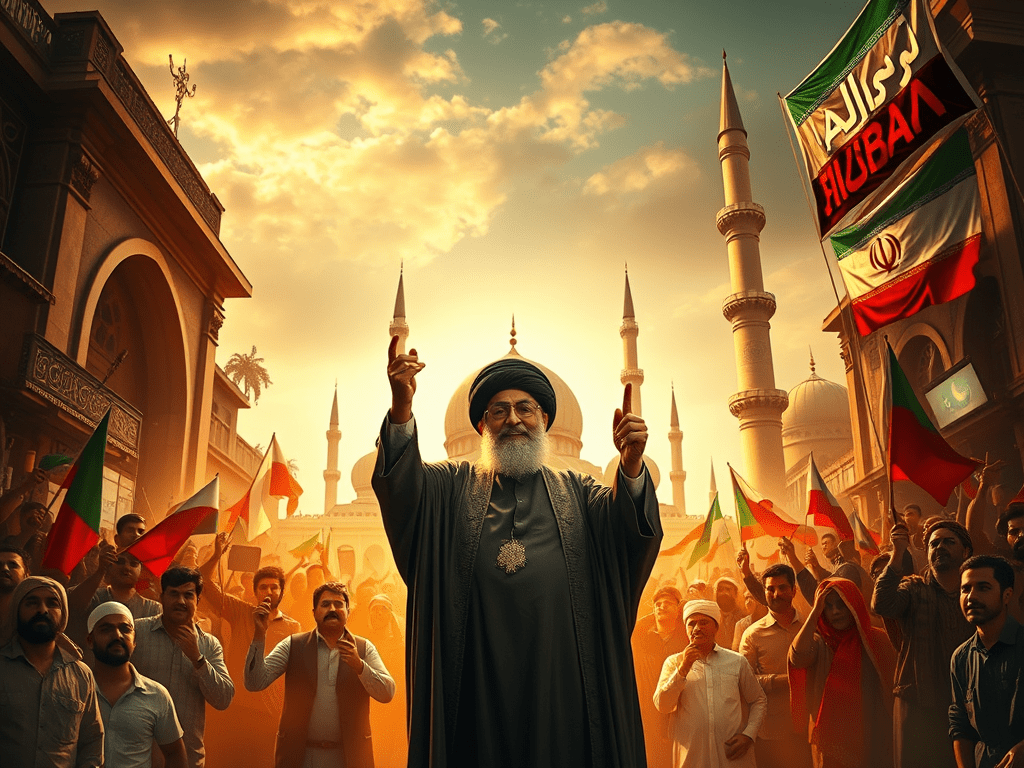
    The upheavals of the two World Wars and the Cold War produced two nations built on the ideology of faith—Pakistan and Iran, respectively. Pakistan emerged as the imperial construct in which religion became a political instrument of military rule. Iran, by contrast, absorbed Marxist polemics of Western imperialism and recast Islamic theology as the engine of a new revolution.

    When V. S. Naipaul visited Iran after the 1979 Iranian Revolution, he found the streets and universities of Mashhad and Qom overrun by believers drawn toward the Ayatollah at the center, surrounded by his coterie, urging, “Iranians should keep the flame of Islam burning.” Ayatollah Taleqani, leading the prayer, spoke about the Prophet’s vision of revolution, and foretold that the Persians—the descendants of Salman-e-Farsi—were to be the pioneers of Islam at a time when the world had deviated from the faith and the ancient debate over true inheritors was to be settled.

    Khomeini’s advertisement in The New York Times in January 1979, while still in exile in France, and his speech on Jerusalem Day in August marked a shift in tone: the conversation moved from claims of equal civilization to the invincibility of faith and its ultimate victory over the world. The liberal world, too, co-opted the Muslim cause globally, framing Iranian resistance and the strife in Gaza as counterpoints to fascism and other manifestations of authoritarianism, conveniently ignoring the colossal failures of their own ideology.

    Revolutionary euphoria quickly gave way to repression. Marxists who had supported the uprising were among the first to be purged. Kurds, Jews, and alleged collaborators soon faced the Supreme Leader’s judgment, and the punishments were swift. Volumes of commentary were written about following the one true faith. The guardians of God became tyrants with solemn faces and flowing gowns, soon revealed as hollow men seeking power over land and veiled women.

    The hard-won revolution had to be protected at all costs, especially from enemies within and beyond the border. The Revolutionary Guard and the long line of Ayatollahs built a fortress of faith. The ranks of Hamas guerrillas, Hezbollah militants, and the surge of the Muslim Brotherhood—armed with belief—were supposed to change the world. However, the domino effect unleashed on October 7 set events in motion.

    How long the war will last, now that the latest Khamenei has exited, and how the IRGC might maneuver to preserve the regime of oppression remains to be seen—only time will tell.

  • Israel and the Baiting Crowd

    When mythology becomes ideology and ideology becomes execution, a darker logic takes hold.

    The blood-curdling acts of cruelty unleashed on civilians in their homes—targeted killings, hostage-taking, and indiscriminate violence—mark a terrifying regression into primal forms of conflict. These actions, as witnessed in recent Hamas attacks, go far beyond political grievance or tactical warfare. They reflect an ideological totality rooted in an unredeemable vision of the enemy. In such a vision, there is no room for coexistence—only elimination.

    Radical Islamic terrorism, such as that espoused by Hamas, draws its fervor from literalist interpretations of religious texts. These scriptures, while diverse and often poetic, are seized upon by extremists to construct closed, absolutist narratives—myths that sanctify violence and demonize the other.

    Yuval Harari, in Sapiens, argues that Homo sapiens rose to dominance not through brute strength but through the unique ability to share stories—fictional narratives that enabled mass cooperation. Religion, like law and nationalism, is among the most enduring of these inventions. These stories—what Harari calls “gossip”—bind individuals into communities. But when transformed into dogma and wrapped in divine authority, they can become weapons.

    This is the foundation of radical Islamist ideology: where myth becomes command, and faith becomes justification for violence. The enemy is no longer just a political adversary, but a moral and ontological threat whose very existence defiles the sacred narrative. The religious story becomes a call to arms.

    The execution of this call finds disturbing resonance in Elias Canetti’s Crowd and Power. Canetti describes the “baiting crowd” as the most ancient and primal form of collective action. It forms around a quickly attainable goal: a victim, clearly marked, defenseless, destined. The crowd moves with single-minded purpose. Each individual strikes a blow, not out of strategy, but out of ritual. The killing is both symbolic and literal—meant to rid the group of its own fear, its own death. Yet paradoxically, after the execution, the crowd disperses, more anxious and fractured than before.

    This, then, is the horrifying convergence: Harari’s myth-making meets Canetti’s crowd impulse. The ideology draws legitimacy from scripture, and the crowd, believing in that narrative, acts it out with blood-soaked devotion.

    In the ideology of Hamas, we see this pattern laid bare. A theology that lionizes martyrdom and promises divine reward collides with a political fantasy of erasing Israel. The result is a mobilized crowd willing to kill and be killed—not as soldiers, but as believers acting out a sacred script.

    What makes this moment more dangerous is the global amplification of this narrative. Despite Hamas’s use of civilians as human shields, its genocidal charter, and its rejection of compromise, there is a rush—in parts of the Islamic world and among segments of the global left—to frame its actions as resistance rather than terror. Israel’s right to self-defense is questioned more than Hamas’s right to exist.

    This signals a disturbing moral inversion. Those who slaughter in the name of God are humanized. Those who retaliate to protect civilians are pathologized. The baiting crowd is no longer confined to streets or battlefields. It has gone virtual, networked, and transnational—spurred on by ideology, grievance, and a prophetic sense of historical destiny.

    Harari ends Sapiens with a warning: that humanity, having acquired godlike technologies, remains dangerously guided by prehistoric instincts. Unless we interrogate the stories we believe in—how they form, how they justify violence, how they sanctify crowds—we risk returning to the oldest form of brutality: the hunting pack, now cloaked in scripture and broadcast to billions.