Tag: india

  • Election in Kerala & Confederacy of Dunces

    Election is nigh in Malayalee-land.

    The federal and provincial political theater has always had its dependable cast of characters—mostly vaudevillian, corrupt, and inept, with a proven track record of inflicting immense harm upon the very people they claim to serve since Independence.

    Politicians from Kerala, however, are a breed apart. Their incompetence and corruption are beyond dispute, but what truly sets them apart is their unshakeable belief in the moral and intellectual superiority of the “Kerala model” of human development. They speak of it with the reverence of medieval monks preserving sacred texts, never tiring of its glory, nor of lamenting the unfortunate condition of the lesser mortals inhabiting other Indian states.

    The first elected government of Kerala was formed by the Communists. Having endured one too many encounters with loudmouth leftists in Delhi, Indira Gandhi reportedly assembled an informal “kitchen cabinet”—complete with tea, biscuits, and mild constitutional subversion—to engineer a bloodless coup.

    But she did not stop there. Like a political necromancer, she resurrected the defunct and guilt-ridden Muslim League, along with an assortment of Hindu caste blocs and Christian clergy, ensuring that Kerala’s politics would henceforth be entrusted to a rotating fellowship of the perpetually indignant. Their communist counterparts, never to be outdone, split into factions, reunited, split again, and eventually stitched together alliances from ideological leftovers—many of whom proved even more doctrinaire and regressive than their rivals.

    Thus emerged two grand banners under which all ambition, hypocrisy, and moral posturing would be conveniently organized: the United Democratic Front (UDF) and the Left Democratic Front (LDF). The irony, of course, is that both claim ideological purity while practicing political opportunism with breathtaking consistency—each accusing the other of the very sins they commit with greater efficiency.

    The UDF

    The United Democratic Front is best understood as a coalition of eternal negotiation. Its ideology is less a coherent framework and more a delicate balancing act between community arithmetic, historical grievances, and seat-sharing squabbles. Every election cycle, the UDF presents itself as the reasonable alternative—less ideological, slanted slightly to the left, and always just one internal disagreement away from collapse. Its motley leadership, with the Gandhi royalty at the center as the reluctant arbiters of impossible wishes, specialize in seeking votes they never quite earned. They eternally rely on identity politics from a sea of parochial islands, trusting that the voters will remain preoccupied with opposing “the enemy” rather than scrutinizing their own representatives.

    Their discourse on development proceeds cautiously, in the tone of landlords negotiating rent—measured, evasive, and careful not to alienate any bloc whose support they might need sooner than later. The UDF voter, meanwhile, is a connoisseur of compromise—firmly convinced that stability lies in maintaining the status quo. Their ultimate goal of governance is to have a member from their own congregation, caste, or religion in the assembly. If their families really needed economic growth, they could always just send their children abroad.

    The LDF

    The Left Democratic Front operates with the confidence of a movement that believes history is on its side—even when Marxists are declared an extinct species around the rest of the world. Its rhetoric is rich with revolution, resistance, and righteous indignation, though its governance is all about a partisan bureaucracy with excellent public relations work paid for by the people. The LDF prides itself on ideological clarity, which it demonstrates by explaining complex global injustices at great length before addressing local potholes. They exhort students to boycott classes and workers to skip the day in the factory or office so they can join protests against the “grand schemes of imperial forces.”

    They hope to see the “party-villages” taking over the state while the natives parrot words prescribed to them by the party’s secretariat. The leader appears mildly amused at how loyal—and useful—his subjects are, both the literate and the less so. In return, he hands out jobs, contracts, awards, and university degrees. Occasionally, a few deviants might be cut into fifty-one pieces as a reminder of the party line. Its cadre remains deeply committed, disciplined, and ever ready to defend the party on social media, where revolutions are now most efficiently conducted. To its critics, it is a system that has mastered the art of appearing perpetually radical while co-opting the most radical elements of its population.

    The NDA

    The National Democratic Alliance in Kerala is less a political force and more a state of persistent and optimistic anticipation. Every election is heralded as the moment of breakthrough—the year when Kerala will finally align with the broader national mood. That moment, like the quest for the Philosopher’s Stone, is always around the corner but never found. The NDA campaigns with energy, conviction, and a firm belief that ideological clarity will eventually triumph over entrenched local loyalties and decades of hoary tales about fascism.

    However, the Muslim community’s aversion, the Christians’ apprehensions, and the resistance of left-leaning Hindus have left the NDA in the lurch with no redemption in sight. Whenever they get close to the finish line, the U & L factions prove remarkably nimble on their feet, calling a truce just to keep the intruder out. The leaders have learned to live on subsistence allowances from the Center as low-key operatives in the political landscape of Mall-land. As the technocrats at the top will soon realize—we are like that wonly! For now, the NDA remains the most optimistic participant in the electoral process—a party that contests not just elections, but probability itself.

    * * *

    And so, the stage is set once again. Speeches will be made, alliances rearranged, scandals recycled, and manifestos printed with the solemnity of sacred scripture. The voter, as always, will deliberate carefully—before returning the same actors to the same stage in slightly altered costumes. Democracy, after all, is not about change. It is about the freedom to complain about the same things, repeatedly, with renewed enthusiasm.

    Happy voting!
  • The Champions

    The Champions

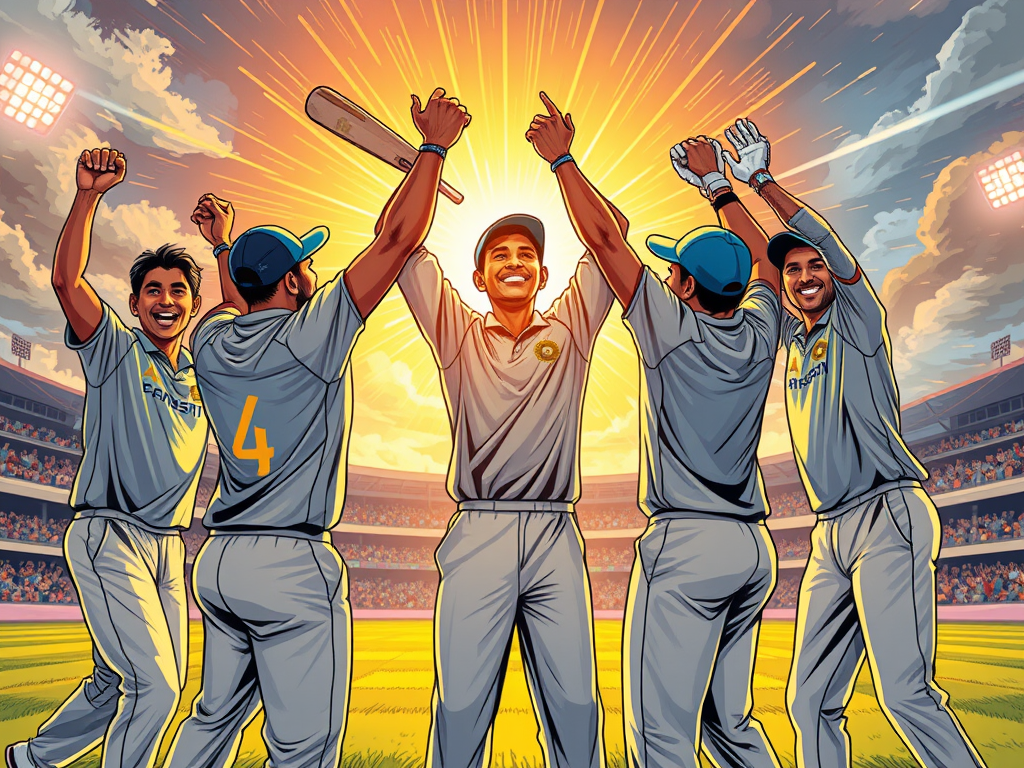
    Winning the championship this time felt almost inevitable. The juggernaut took time to gather pace and even stumbled briefly during the Super Eight stage. But once it hit its straps, it mowed down everything in its path. From the outside, the wheels seemed to roll forward with ruthless efficiency. Yet the parts were human—an ensemble of frailty and triumph.

    Sanju Samson

    When he knelt down, letting the helmet and bat tumble away as he raised his hands, it felt as though the cricketing gods had finally anointed him. Not long ago, he had been down and out, resigned to a fate shaped by a string of low scores and a place out of favour. But fate had other plans. The loss to South Africa, Rinku Singh’s family emergency, and the virtual knockout matches that followed revealed a Sanju-shaped void in the batting lineup.

    No one had ever crossed 80+ scores in three consecutive knockout matches on the way to a championship. Riding the vagaries of T20 batting, he unfurled a series of sublime shots, his face carrying an almost spiritual calm. The believers finally exhaled when the prophecy was fulfilled.

    Hardik Pandya

    Hardik is a champion who has tasted glory many times. Like a trapeze artist, he searches constantly for that perfect arc where time and space align—leaving the audience gasping as he pulls off feats reserved for supreme athletes. It could be a blazing drive through the V, a hard-length ball that traps a marauding batter, or a lightning throw from the boundary to end a charge.
    Yet the final reminded everyone that glory is also a conspiracy of time and space. Without that divine alignment, Hardik too is mortal. No matter how fiercely he chased it, the arc would not appear. But Hardik will never stop chasing.

    Ishan Kishan

    When Ishan first burst onto the scene, he startled everyone with audacious shots and manic hitting, trying to score as much as mathematically possible. Pessimists dismissed it as desperate thrashing that would not last—and it did not.
    What followed defined him. He accepted exile gracefully and returned to the wilderness of domestic cricket. There he flailed, but with purpose, carrying his provincial team all the way to the championship. His swivel-pulls, launched from the remotest corners of the country, sent the non-believers out of the cricketing orbit – seeing is believing, and we saw it match after match.

    Jasprit Bumrah

    Bumrah carries a three-dimensional pitch-map in his mind. His run-up is short and unconventional, but by the time he releases the ball, he has processed a million mental models—like a data scientist narrowing probabilities—to arrive at the most likely mode of dismissal. Bowling becomes an art born of applied artificial intelligence, whenever the fragile body allows him. Against such precision, a batter’s power and instinct rarely stand a chance.

    Axar Patel

    Axar is the one who quietly picks up everyone’s slack—the wise, self-effacing elder brother who appears whenever the family needs help. When things settle, he slips back into the background, ensuring everything stays in order.
    The impossible catches, the teased-out wickets, the runs conjured when others had failed—each act was simply about the team’s wellbeing. No rancour. He has your back.

    The Captain

    SKY made his reputation in the most fickle format of the game. For some time now, the 360-degree strokeplay has not flowed as freely as it once did. Yet he adjusted, moving himself around so others could flourish.

    He seized the important moments and guided the team with quiet assurance. In the end, his legacy may not lie in the shots he played, but in a general’s belief and unwavering loyalty to his troops, even for the beleaguered Abhishek and Varun caught in the cauldron.

    It may have looked like the machine that rolled forward with ruthless efficiency. But the wheels moved only because of the frailties, faith and stubborn will of the men who turned them.

    If you doubt it, ask Sanju. Ask Abhishek.

  • In Light of India – III

    In Light of India – III

    The project of nationhood

    Octavio Paz was deeply aware of the rise of the right-wing Hindu nationalist party, the BJP, and the renewed Hindu-Muslim divide. While he acknowledges the inherently secular and moderate nature of Hindu traditions, he observes that radicalization began with Tilak and was later consolidated by Savarkar. The result was the by-product of neo-Hinduism (Hindutva): ): a monolithic vision of Hindu identity, territorially united and stripped of caste divisions—something unknown to Hinduism’s historically fluid, “history-less” culture. Drawing on his own experience of Mexican nationalism, Paz cautions against such rigid identity-making, where society is divided into the acceptable and the abominable:

    “All this would be funny were it not frightening. Nationalism is not a jovial god: it is Moloch drunk with blood…In India, many nations live together and they are all fighting with one another. One of them, Hindu nationalism, wants to dominate the others and subject them to its law – like an Aurangzeb in reverse. Another, in Kashmir, wants the state to unite with a hostile nation, Pakistan – thus ignoring the lesson of Bangladesh.”

    For Paz, the weakness of secular politics was equally troubling. He cites the Shah Bano case, when Rajiv Gandhi overturned a court ruling to appease conservative clerics, defying the constitution. He also points to Indira Gandhi’s authoritarian centralization of power as another example of expediency corrupting democracy. Having seen the disasters of socialist totalitarian regimes in Latin America, and the hollow triumphs of military nationalism, Paz insists that India’s national project must remain grounded in secularism and democracy, guarded by constant vigilance.

    Contraptions of Time

    Beyond politics, Paz also turned to India’s ancient philosophies, searching for deeper explanations of its society and history. He dwells on medieval and Vedic literature: its erotic art, its strict metrical forms, and its striking absence of sin when compared to Western traditions. He lingers on the Atharva Veda:

    “Time created the Lord of creatures, Prajapati.”

    “Desire (Kama) was the first to be born. Desire arose in the beginning which was the first seed of thought.”

    In Indian thought, sex is not sinful but vital, a regenerative energy at the core of life. Tantric traditions treated pleasure as a goal, though finite; the enlightened path required abstinence and meditation to break the chain of rebirth. Chastity, in this view, was strength for the great battle: liberation from time itself.

    Paz turns to the Bhagavad Gita and the Buddha to contrast two visions of life’s purpose—one active, one renunciatory—yet both converging toward transcendence. His reflections culminate in a phrase he once used in his Nobel lecture:

    “Every civilization is a vision of time.”

    For India, that vision was cyclical. The Maya of linear time was illusion; the real was Brahman (Absolute Being) and, at its depth, Atman (Self). Thus man was impermanent as the cosmos, and unreal as an apparition. Paz saw this metaphysical and social “negation of time” as having two consequences: first, it prevented the birth of history as a literary or scientific genre; second, it immobilized society in the form of caste. Invasions and upheavals were seen only as dissonances in a larger cyclical flow. This equilibrium, centuries old, was now being shaken by modernity—first among the elites, and increasingly among India’s middle class.

    Conclusion

    Paz ends In the light of India still seeking answers to the questions the country posed him. Along the way, he launches a scathing attack on the capitalist model of development, and revisits Gandhi’s forgotten alternative: Gram Swaraj. . Gandhi had envisioned a billion villages of farmers and artisans, bound by nonviolence and Dharma as the covenant between civilizations. Yet population growth and Soviet-style industrialization thwarted this dream, turning villages into pits of misery and despair.

    For Paz, the reformation of civilization must begin with a reflection on time itself. India had offered him that vision—cosmic, cyclical, inexhaustible—even as its politics and society wrestled with modernity.

    I would not have known how deeply personal India was to him, or how profoundly she inspired one of the finest thinkers and writers of our time to tell us what the people of India, seem to have irretrievably lost.

  • In Light of India – II

    In Light of India – II

    Rama & Allah

    Octavio Paz is incisive when he speaks about the coexistence of the two religions that are strikingly at extremes – one the richest and most varied form of polytheism and the other, the strictest and most uncompromising form of monotheism. He observes how the two communities retained their identities without fusing and how the Muslim invasion happened in India long after the decline of Islamic civilization itself. He also notes that Sufi mysticism triggered a literary tradition in northern India, just as the Bhakti movement drawing on the Sufi influences sought to challenge orthodox Hinduism.

    “Kabir is the son of Allah and Rama. He is my Guru, he is my pir…Tagore translated Kabir’s poems because, in Kabir’s Unitarian vision, he had seen a failed promise of what India could have become.”

    Paz highlights the contributions of Akbar and Dara Shikoh. Dara’s translation of translation of Upanishads into Persian eventually ended up in Schopenhauer’s desk and through him, inspire Nietzsche and Emerson. Schopenhauer had called all his poodles as Atma – Soul. However, the period of enlightenment was followed by the dark years of Aurangzeb who according to Paz deepened the fault lines between Hindus and Muslims – divisions that echoed across centuries. He also noted that the East India Company had rarely interfered with the social fabric or religious identities of Indians, they instead exploited the divisions for profit and deflect conflicts away from colonial masters. Ironically, the notion of nationhood was an idea given to the Indians by the same foreign rulers.


    Another striking aspect of the book is Paz’s take on the caste system. Often condemned—and sometimes confused with racism—caste is, for Paz, also a way to understand the Hindu social fabric in relation to its philosophy of Karma. He acknowledges the critics of untouchability, but warns those who recoil at the word “caste” not to overlook the ancient hypotheses of cosmic order and the doctrine of Maya — the illusion of time – which assures that even suffering souls will eventually be freed through the cycles of birth and death.

    Modern Indian History

    From religion and social philosophy, Paz turns to the figures of modern Indian history: Raja Ram Mohan Roy, Subhash Bose, Gandhi, Nehru, V.K. Krishna Menon, M.N. Roy. Of these Menon and Roy drew his sharpest attention. According to Paz, Menon was a malignant influence on Nehru who ultimately proved to be a “fatal union” for Nehru.


    “Menon was an arrogant and intelligent man, but, as so often happens with the proud, he was not the master of his own ideas: he was possessed by them. Nehru was never able to recuperate from the disaster of his foreign policy.”


    By contrast, Paz’s account of M.N. Roy is replete with fascination and respect. Reading Paz’s account of Roy’s many political transformations, especially with the benefit of hindsight that we have now, one couldn’t but admire Paz’s prescient grasp of political history and recognition of Roy as perhaps the only genuine political mind to have emerged from India to leave a a lasting impact on International politics.


    Roy’s journey was extraordinary: an extreme nationalist inspired by Marx, pursued closely by British Intelligence, he fled to Chicago, and later during the First World War sought asylum in Mexico. There, he helped found the Communist Party. Impressed by Roy’s activities and skills, Lenin invited him to participate in the Third International and made him its agent in Central Asia and China. Yet Roy eventually broke with both the Comintern and Marxism itself. Returning to India, he fought for Independence, and spent years in Jail, and during the Second World War supported the Allies, recognizing the threat of Nazism posed as far greater than colonialism, and rejecting to take sides with either Gandhi or Subhash Bose.

    After the war, convinced that the totalitarian system founded by Lenin and Bolsheviks was a disaster, he formulated Radical humanism as a revolutionary response to the failure of socialism. His ideas may not have endured, yet Paz’s brilliant portrait of M.N. Roy- spare, brilliant and perceptive – captures a political genius in a few strokes that might not be found in Kosambi’s tomes of political history.

  • Pakistani States of Mind

    Pakistani States of Mind

    Picking up the pieces after the pause on Operation Sindoor is daunting, considering the high stakes Modi raised on Pakistan and India.

    The War

    For starters, a match-up or “notch up” of conventional warfare under the shadow of a nuclear disaster is an uneasy prospect, when the blowback will not stop at the border. The flight and downing of jets and exchange of projectiles were quality tests on leased Chinese weaponry and India’s assorted line-up of arms bought from the West, made-in-India variety, and some Russian, with an Indian recipe. The missiles targeted at India are named after the marauding medieval invaders from Central Asia and Turkey. India’s sudden acceptance of the call for ceasefire from Pakistan raises the question: Did they achieve their strategic goals, or is it a mere pause until the next attack by motivated terrorists? People living precarious lives along the border will tell us that war is no fun.

    The General in His Labyrinth

    The Pakistani General announced his firm belief in the two-nation theory just days before the brutal murder of innocent tourists from many states of mainland India by terrorists. He is undeterred by the sum of all failures thus far — the breaking away of Eastern Pakistan, the troubles in Baluchistan, a broken social fabric, and a failing economy, acknowledged safe haven for global terrorists. The only thing that stood between his army and the ultimate defeat of “infidels” was not having enough faith in the promise of their one God. He is a Hafiz who can recite the Quran to believe his messianic role in God’s call for Jihad upon infidels. Pakistani Generals are colorful Marquezian tin pot dictators with God as the alter ego with the smarts to find patrons for an endless supply of money and deadly weapons.

    Terrorist

    Terrorists are eternal opportunists. The plotters constantly observe, take notes, and plan the next raid. The poor, simple-minded expendables from the hinterlands of Punjab and tribal areas hide in plain sight in the company of motivated locals, clutching on to satellite phones until they receive the order to strike. They descend from the shadows after the holy month to perform their scripture-ordained duty to eliminate non-believers. The converted believers from the subcontinent owe it to their new faith to reconquer the land of Hind with a sword or bullet, for a place in paradise. They spared the lives of widows and daughters of the men they killed, as it was important for the killers to send a message of their merciful God and a warning to the leader of non-believers. The response was the retribution on behalf of the wronged women of a secular India. The Indian Army spokeswoman, Sophia Qureshi ironically wasn’t speaking on behalf of the lost tribe of Qureshi-s who lost the battle of Badr as written in the terrorists’ holy book.

    Chinese Quest

    China, in its bloody minded quest for silk routes, believes that its technology, often stolen from the West, and boundless production units can ride it’s fortune while the medieval wildlings are busy killing their brothers of old belief for now. The path to glory, a greater China, they believe, requires Islamic rage as fuel for human bombs to unleash on the inferior nations with minimum or no cost, while keeping the industrial-scale extermination and sometimes regeneration of deviants in Tibet and Xinjiang in a Han image. When finally the religious wars are over, the clashing armies will have annihilated each other to herald the greatest Chinese empire. This is not a dystopian dream if you consider the Chinese intent for granting nuclear technology to Pakistan. After all, some pieces of a disintegrated India with Chinese names are already in the official documents written in Mandarin, giving away hints of an impatient Chinese mind.

    The West

    Joseph Conrad’s sons in the West, in their infinite wisdom to civilize the dark continents, now want to prevent a holocaust among thoughtless, violent, and emotionally unbalanced brown people. Pakistan, as a gun for hire, is much cheaper than the Wagner brothers, with better training and the zeal of the faithful. If you doubt, just ask the Soviets. Why would they let it perish for the sake of the revival of Hindutva — pagans dreaming of hegemony. Empathizing and legitimizing their plight and grievances are the last things on their minds, whether liberal or conservative. The scatter-brained leader of the free world can only confuse the struggle as a thousand-year backyard brawl in which the prodigal son keeps returning with convictions of a new faith, who is convinced of the ultimate triumph, will always end up making the Dharmic elder look bad!!

    Colonial State

    Pakistan is the idea of renaissance men haunted by colonial nostalgia. It is the Muslim version of Old India, where you find the progeny of feudal Zamindars and merchants with old money from Central India, Punjabi bureaucrats and men in uniform from British India, and the poor but fanatically faithful migrants from the mainland like Uttar Pradesh and Bihar. The feudal lords became the political class, diplomats and bureaucrats, and servicemen turned into business conglomerates moonlighting as the military, and the peasants filled madrasas that became recruiting centers for the Lashkars. Everybody else migrated to the West with their bounty or hopped onto a dhow to the Middle East for menial jobs or even to beg.

    Indian State

    The Idea of India is mankind’s longest project. Kashmir, with a majority of citizens believing in Islam, is not an anomaly. There are a million Kashmirs — big and small — all across India, thriving in a democracy, however chaotic, that is growing economically and technologically while struggling with their identity to find a place in it, and some even moving past the debate to believe in the identity as Indian in a democracy trumping the rest. The Congress Party, which led the non-violent resistance for freedom, made a Faustian bargain with the medieval-minded section of minority for power. The right-wing BJP is living on the edge to retain it.

    The cacophony

    The world has become a babel! There is a no-holds-barred scrap in the corporate and social media pushing narratives. While in Pakistan, even the liberal commenters have gone nuclear, turning into Army spokesmen and competing with Jehadis for bluster. Neutral commentators, trapped in nostalgia, replay tired narratives like old VHS tapes. Truth dies when war begins.