Tag: history

  • Debating AI

    Debating AI

    The content below is a summary of the arguments I presented during my debate with Gemini AI. Summary is also a product of Gemini’s infinite wisdom in TPUs.

    ————————

    …that was a very detailed and nuanced discussion. Your arguments focus on the critical shortcomings of the Nehruvian project and the idea that Nehru’s political choices inadvertently created and sustained India’s core internal and external challenges.

    Here is a summary of the main arguments you put forward:

    1. The Danger of Flawed Idealism (Nehru vs. Patel):

    The Thesis: Idealism, when based on a wrong hypothesis and neglecting ground facts or the policies of rivals, is more dangerous than pragmatism.

    The Critique of Nehru: Nehru’s idealism (e.g., in foreign policy) led to a strategic failure (e.g., ignoring Patel’s warnings on China and the security of Tibet) and favoured a moralistic approach (UN on Kashmir) over a decisive, realistic, and preemptive one.

    The Counter-View of Patel: Sardar Patel’s pragmatic, realist, and less state-socialist approach would have been more progressive and beneficial for national security and economic growth, despite being deemed “less progressive” by the prevailing socialist ideology of the time.

    2. Intellectual Inflexibility and Image Maintenance:

    The Argument: Nehru’s deep intellectual confidence and commitment to a specific ideology (democratic socialism) may have functioned as a shield to avoid honest debate and critical engagement with policy failures.

    The Consequence: This created a risk where unchallenged ideas and policies amounted to “gambling” with the future of one-fifth of the world’s population, leading to the institutionalisation of detrimental systems.

    3. Bad Policies vs. Good Intentions (Institutionalising Corruption):

    The Critique of the Economic Model: The construction of modern infrastructure and scientific institutions does not excuse the creation of the “License Raj” and the institutionalisation of corruption.

    The Mechanism: The excessive centralised state control and bureaucratic intervention required for Nehruvian planning created endless points for rent-seeking and stifled private enterprise and genuine growth for decades.

    4. Failure of Secularism and Internal Fragmentation:

    Flawed Secularism: Nehruvian secularism was not a tool for genuine reformation and integration for all minorities, but rather one of non-interference (e.g., failing to reform Muslim Personal Law while reforming Hindu law).

    External Exploitation: This selective approach created a sense of an “unintegrated” population (especially in regions like Kashmir and Bengal), which became the ideological justification and strategic leverage point for Pakistan, despite its meagre resources, to challenge India’s integrity and prosperity.

    5. Conclusion on Gandhi’s Vision:

    The final summation is that the implemented hybrid vision—a mix of Nehru’s modernism and a diluted version of Gandhian pluralism—led to the creation and sustenance of intractable enemies both internally (communalism/fragmentation) and externally (unresolved conflicts with Pakistan and China), ultimately hindering India’s true potential and security.

    —————-scary!!

  • In Light of India – III

    In Light of India – III

    The project of nationhood

    Octavio Paz was deeply aware of the rise of the right-wing Hindu nationalist party, the BJP, and the renewed Hindu-Muslim divide. While he acknowledges the inherently secular and moderate nature of Hindu traditions, he observes that radicalization began with Tilak and was later consolidated by Savarkar. The result was the by-product of neo-Hinduism (Hindutva): ): a monolithic vision of Hindu identity, territorially united and stripped of caste divisions—something unknown to Hinduism’s historically fluid, “history-less” culture. Drawing on his own experience of Mexican nationalism, Paz cautions against such rigid identity-making, where society is divided into the acceptable and the abominable:

    “All this would be funny were it not frightening. Nationalism is not a jovial god: it is Moloch drunk with blood…In India, many nations live together and they are all fighting with one another. One of them, Hindu nationalism, wants to dominate the others and subject them to its law – like an Aurangzeb in reverse. Another, in Kashmir, wants the state to unite with a hostile nation, Pakistan – thus ignoring the lesson of Bangladesh.”

    For Paz, the weakness of secular politics was equally troubling. He cites the Shah Bano case, when Rajiv Gandhi overturned a court ruling to appease conservative clerics, defying the constitution. He also points to Indira Gandhi’s authoritarian centralization of power as another example of expediency corrupting democracy. Having seen the disasters of socialist totalitarian regimes in Latin America, and the hollow triumphs of military nationalism, Paz insists that India’s national project must remain grounded in secularism and democracy, guarded by constant vigilance.

    Contraptions of Time

    Beyond politics, Paz also turned to India’s ancient philosophies, searching for deeper explanations of its society and history. He dwells on medieval and Vedic literature: its erotic art, its strict metrical forms, and its striking absence of sin when compared to Western traditions. He lingers on the Atharva Veda:

    “Time created the Lord of creatures, Prajapati.”

    “Desire (Kama) was the first to be born. Desire arose in the beginning which was the first seed of thought.”

    In Indian thought, sex is not sinful but vital, a regenerative energy at the core of life. Tantric traditions treated pleasure as a goal, though finite; the enlightened path required abstinence and meditation to break the chain of rebirth. Chastity, in this view, was strength for the great battle: liberation from time itself.

    Paz turns to the Bhagavad Gita and the Buddha to contrast two visions of life’s purpose—one active, one renunciatory—yet both converging toward transcendence. His reflections culminate in a phrase he once used in his Nobel lecture:

    “Every civilization is a vision of time.”

    For India, that vision was cyclical. The Maya of linear time was illusion; the real was Brahman (Absolute Being) and, at its depth, Atman (Self). Thus man was impermanent as the cosmos, and unreal as an apparition. Paz saw this metaphysical and social “negation of time” as having two consequences: first, it prevented the birth of history as a literary or scientific genre; second, it immobilized society in the form of caste. Invasions and upheavals were seen only as dissonances in a larger cyclical flow. This equilibrium, centuries old, was now being shaken by modernity—first among the elites, and increasingly among India’s middle class.

    Conclusion

    Paz ends In the light of India still seeking answers to the questions the country posed him. Along the way, he launches a scathing attack on the capitalist model of development, and revisits Gandhi’s forgotten alternative: Gram Swaraj. . Gandhi had envisioned a billion villages of farmers and artisans, bound by nonviolence and Dharma as the covenant between civilizations. Yet population growth and Soviet-style industrialization thwarted this dream, turning villages into pits of misery and despair.

    For Paz, the reformation of civilization must begin with a reflection on time itself. India had offered him that vision—cosmic, cyclical, inexhaustible—even as its politics and society wrestled with modernity.

    I would not have known how deeply personal India was to him, or how profoundly she inspired one of the finest thinkers and writers of our time to tell us what the people of India, seem to have irretrievably lost.

  • In Light of India – II

    In Light of India – II

    Rama & Allah

    Octavio Paz is incisive when he speaks about the coexistence of the two religions that are strikingly at extremes – one the richest and most varied form of polytheism and the other, the strictest and most uncompromising form of monotheism. He observes how the two communities retained their identities without fusing and how the Muslim invasion happened in India long after the decline of Islamic civilization itself. He also notes that Sufi mysticism triggered a literary tradition in northern India, just as the Bhakti movement drawing on the Sufi influences sought to challenge orthodox Hinduism.

    “Kabir is the son of Allah and Rama. He is my Guru, he is my pir…Tagore translated Kabir’s poems because, in Kabir’s Unitarian vision, he had seen a failed promise of what India could have become.”

    Paz highlights the contributions of Akbar and Dara Shikoh. Dara’s translation of translation of Upanishads into Persian eventually ended up in Schopenhauer’s desk and through him, inspire Nietzsche and Emerson. Schopenhauer had called all his poodles as Atma – Soul. However, the period of enlightenment was followed by the dark years of Aurangzeb who according to Paz deepened the fault lines between Hindus and Muslims – divisions that echoed across centuries. He also noted that the East India Company had rarely interfered with the social fabric or religious identities of Indians, they instead exploited the divisions for profit and deflect conflicts away from colonial masters. Ironically, the notion of nationhood was an idea given to the Indians by the same foreign rulers.


    Another striking aspect of the book is Paz’s take on the caste system. Often condemned—and sometimes confused with racism—caste is, for Paz, also a way to understand the Hindu social fabric in relation to its philosophy of Karma. He acknowledges the critics of untouchability, but warns those who recoil at the word “caste” not to overlook the ancient hypotheses of cosmic order and the doctrine of Maya — the illusion of time – which assures that even suffering souls will eventually be freed through the cycles of birth and death.

    Modern Indian History

    From religion and social philosophy, Paz turns to the figures of modern Indian history: Raja Ram Mohan Roy, Subhash Bose, Gandhi, Nehru, V.K. Krishna Menon, M.N. Roy. Of these Menon and Roy drew his sharpest attention. According to Paz, Menon was a malignant influence on Nehru who ultimately proved to be a “fatal union” for Nehru.


    “Menon was an arrogant and intelligent man, but, as so often happens with the proud, he was not the master of his own ideas: he was possessed by them. Nehru was never able to recuperate from the disaster of his foreign policy.”


    By contrast, Paz’s account of M.N. Roy is replete with fascination and respect. Reading Paz’s account of Roy’s many political transformations, especially with the benefit of hindsight that we have now, one couldn’t but admire Paz’s prescient grasp of political history and recognition of Roy as perhaps the only genuine political mind to have emerged from India to leave a a lasting impact on International politics.


    Roy’s journey was extraordinary: an extreme nationalist inspired by Marx, pursued closely by British Intelligence, he fled to Chicago, and later during the First World War sought asylum in Mexico. There, he helped found the Communist Party. Impressed by Roy’s activities and skills, Lenin invited him to participate in the Third International and made him its agent in Central Asia and China. Yet Roy eventually broke with both the Comintern and Marxism itself. Returning to India, he fought for Independence, and spent years in Jail, and during the Second World War supported the Allies, recognizing the threat of Nazism posed as far greater than colonialism, and rejecting to take sides with either Gandhi or Subhash Bose.

    After the war, convinced that the totalitarian system founded by Lenin and Bolsheviks was a disaster, he formulated Radical humanism as a revolutionary response to the failure of socialism. His ideas may not have endured, yet Paz’s brilliant portrait of M.N. Roy- spare, brilliant and perceptive – captures a political genius in a few strokes that might not be found in Kosambi’s tomes of political history.

  • Crowd, Power and Space

    Crowd, Power and Spaces

    Israel is up against a triple crowd surging in three-dimensional space doubling down on its maximalist demands to find some ways to vanish from the center of their universe —morally, militarily, and symbolically. It’s not merely a military conflict; it’s a struggle over legitimacy, truth, and the right to exist as a liberal democracy amid ideological absolutism.

    The First Crowd

    Having raided across the lines of enemy territory, the savage plunderers chosen by the tribal gods exacted untold trauma and brought enough prisoners. They formed the first crowd to do the job of baiting the armed foes coming in with survivors’ guilt and irrational haste to the arena. Physically they have surrounded themselves with concentric circles of prisoners and people from their own tribe.

    The Second crowd

    Both prisoners and unarmed civilians form the firewall even the cruelest dictator would dream about. They are the crowds of lament. The worse their plight becomes, the enemy’s will to fight worsens. The terrorists wish nothing but the worst inflicted upon them and suffer immeasurably from the fury of retribution. It is indeed heartbreaking to watch death and destruction in the wake of an apocalypse and a densely packed city laid asunder.

    The Third crowd

    The marching crowds in the world’s cities and schools demanding complete surrender to what they will ask next is possibly the most dangerous of the three. Champions of ideologies – both religious and liberal kind found an intersection in their disdain for democracy and lust for power to close down avenues for dialogue, coexistence, and peace. Their politics of grievance gives them the opportunity to destabilize the world order and hope for another Iran or a resurrection of Soviet Gulags out of the rubble. They believe the union outmaneuvers reason and logic with intentionally loud and prosaic phrases like apartheid, occupation, open prison, etc., while promising that the crowd will overrun the few million Jewish survivors shortly, notwithstanding their deadly weapons of mass destruction. They do not have the patience to listen to the stories from the holocaust.

    Three-dimensional space

    The terrorists spent their entire fortune building a metro of tunnels under their city of squalor and suffering. They crawl out of the holes to inflict pain on others or draw them into the dark traps of death.

    The population living above ground in the ghastly city is held hostage to the regime of terror while being the willing and fertile source to recruit their rank and file.

    The sympathizers all over the world occupy spaces in the multiverse of the internet, town squares, the labyrinth of universities, and ghettoes where immigrants import unsolvable animus from the dark ages.

  • Israel and the Baiting Crowd

    When mythology becomes ideology and ideology becomes execution, a darker logic takes hold.

    The blood-curdling acts of cruelty unleashed on civilians in their homes—targeted killings, hostage-taking, and indiscriminate violence—mark a terrifying regression into primal forms of conflict. These actions, as witnessed in recent Hamas attacks, go far beyond political grievance or tactical warfare. They reflect an ideological totality rooted in an unredeemable vision of the enemy. In such a vision, there is no room for coexistence—only elimination.

    Radical Islamic terrorism, such as that espoused by Hamas, draws its fervor from literalist interpretations of religious texts. These scriptures, while diverse and often poetic, are seized upon by extremists to construct closed, absolutist narratives—myths that sanctify violence and demonize the other.

    Yuval Harari, in Sapiens, argues that Homo sapiens rose to dominance not through brute strength but through the unique ability to share stories—fictional narratives that enabled mass cooperation. Religion, like law and nationalism, is among the most enduring of these inventions. These stories—what Harari calls “gossip”—bind individuals into communities. But when transformed into dogma and wrapped in divine authority, they can become weapons.

    This is the foundation of radical Islamist ideology: where myth becomes command, and faith becomes justification for violence. The enemy is no longer just a political adversary, but a moral and ontological threat whose very existence defiles the sacred narrative. The religious story becomes a call to arms.

    The execution of this call finds disturbing resonance in Elias Canetti’s Crowd and Power. Canetti describes the “baiting crowd” as the most ancient and primal form of collective action. It forms around a quickly attainable goal: a victim, clearly marked, defenseless, destined. The crowd moves with single-minded purpose. Each individual strikes a blow, not out of strategy, but out of ritual. The killing is both symbolic and literal—meant to rid the group of its own fear, its own death. Yet paradoxically, after the execution, the crowd disperses, more anxious and fractured than before.

    This, then, is the horrifying convergence: Harari’s myth-making meets Canetti’s crowd impulse. The ideology draws legitimacy from scripture, and the crowd, believing in that narrative, acts it out with blood-soaked devotion.

    In the ideology of Hamas, we see this pattern laid bare. A theology that lionizes martyrdom and promises divine reward collides with a political fantasy of erasing Israel. The result is a mobilized crowd willing to kill and be killed—not as soldiers, but as believers acting out a sacred script.

    What makes this moment more dangerous is the global amplification of this narrative. Despite Hamas’s use of civilians as human shields, its genocidal charter, and its rejection of compromise, there is a rush—in parts of the Islamic world and among segments of the global left—to frame its actions as resistance rather than terror. Israel’s right to self-defense is questioned more than Hamas’s right to exist.

    This signals a disturbing moral inversion. Those who slaughter in the name of God are humanized. Those who retaliate to protect civilians are pathologized. The baiting crowd is no longer confined to streets or battlefields. It has gone virtual, networked, and transnational—spurred on by ideology, grievance, and a prophetic sense of historical destiny.

    Harari ends Sapiens with a warning: that humanity, having acquired godlike technologies, remains dangerously guided by prehistoric instincts. Unless we interrogate the stories we believe in—how they form, how they justify violence, how they sanctify crowds—we risk returning to the oldest form of brutality: the hunting pack, now cloaked in scripture and broadcast to billions.

  • Atlantis, the lost island of childhood

    Atlantis, the lost island of childhood

    In the beginning, as far as I can remember, the lush green strip of land was ensconced by the Arabian Sea and a thin river line that was lost into an estuary. A billion species of life thrived in the tiny whirlpools. Sunshine fell on the flowing waters in every fissure. When it rained, the natives who lived in the shanty could see the silver lines of thunder afar and scampered to bring the cows and kids home from the field and the wantons of country roads. The wind wove a symphony across the countless coconut trees that arched over the white and golden sand dunes. Folks called the place – an island, with no name, perhaps to remind the sovereignty of the land that leant over the timeless ebb and flow of the ocean.

    I used to visit my grandparents’ house during our summer vacations. We, the boys from the city found our space and deflated the overcrowded time from our senses on the island. The travel included trekking by bus and ferry boats, finally walking more than a mile passing paddy fields and country roads paved with soft red soil and sand until we reach the Riverbend and holler for the ferry as we soak in the wet breeze wiping away the last trace of fatigue.

    The folks in the house had to paddle across the river for everything that they ever needed, and every household had its own boats. The nights were dense and we could see each other’s faces in sepia sitting across the kerosene lamps for dinner. Eight siblings and dozens of grandkids thronged the spacious and benevolent home during those unforgettable times. If I close my eyes, I can still see the shimmering torch lights of solitary pedestrians on those rugged paths by the river and fisher folks rowing by.

    It must be right after the famine in the forties, my grandfather and his brothers left their misery to follow a dream of a piece of land to call their own. I never asked him to chronicle the events or timeline. They had nothing and everything to fight for. The island was waiting for them to build the Promised Land, and the earth was nubile and feisty. He had plowed his way and unleashed the raw power of farmers and fishermen to build the house, cultivate the land and build boats to fish with a lot of camaraderie with his brothers and natives.

    As kids, we spent the summer vacations in exhilaration, playing on top of the piles of coconuts and grains; canoeing up and down streams; gathering around the table where everyone assembles for dinner and woke up with the roar of waves retreating from the back of the house every morning. My grandfather looked like Odysseus who just came home to Ithaca, having done his journey.

    I spent a lot of time with him listening to his monologues on movies he watched from the country movie theatre or the quality of carpenters who worked on his boats. He also spoke about the murderous sea storms and fights among fisher folks who haunted the evening taverns with a kind of defiant nonchalance. He was Hemingway’s Santiago who came from the sea with the biggest fish I could ever imagine sculling the boat from the horizon, but he was not weary.

    I never asked my grandfather about his journey, rather I was basking in his days of glory. But then things took a different course ever since he folded himself into retirement. My aunts were all married off and had more significant issues in life and kids to gather around, my uncles vanished into the crowds in different parts of India and outside in search of jobs.

    Society itself was undergoing the customary changes as always has been. The deluge of foreign money and pomp of Gulf country residents rolled over the spirit of the land. The old house was abandoned and the grandparents were transplanted to the new home built near the highway and surrounded by walls. The rain, the wind, the undulating expanse of coconut trees, and the waves from the ocean were shut out for the rest of their lives.

    Grandma died first and Grandfather followed her soon. Even the new house looks so old now, occupied now by one of my uncles. He might probably visit once in a while from Dubai where he found a job. The dilapidated and moth-ridden old house bid the last moments of its existence before it was smashed down, probably to build a concrete warehouse for fertilizers. Now that the island has been named and electrified.

    Atlantis, the lost continent is considered to be the source of all Religion, all Science, and all races and civilizations. As we enter the third millennium, the Age of Aquarius its discovery is deemed to cause a major revolution in our view of the world and of both our future and past. I found my Atlantis on that island a while ago when I was a kid. The hearts and minds of the dwellers who built a brave new world over there, though lost, would still speak to you if you listen. That this world can still be mysterious and beautiful if you can spare a moment to grasp.

  • Invisible Cities

    Invisible Cities

    Italo Calvino’s Invisible Cities is a skinny book that condenses the experience and idea of living and feeling cities in abstract and manifest ways. It has been a prized possession since I was a student even though I read it a long time ago and still read random chapters. I got hooked by the matter-of-fact, almost parable-like but incisive visions set ablaze in each chapter of the book, which unveils a different city as narrated in an imaginary conversation between Kublai Khan, the Tatar emperor, and Marco Polo, the traveler. Marco talks about the cities with such great tangents and flourish, leaving you gasping at the delightful insights.

    The lyrical narrative of cities is replete with symbolisms and metaphors. These serve as the readers’ devices to begin their treatises on reality and fiction, memory and desire, and past and present. Calvino masterfully writes about the limitation of communication and power, ephemeral but universal cycles of urban living among the ruins and glory of concrete columns, cities as projections of human psyche, and the possibility of whims and greed as cogent sources of creativity. You could try and ponder over Calvino’s dispatches from the book on some of the real cities and their architects – the tunnel cities in China, Berlin, Turkey and those under Gaza and South Lebanon, Ghost city of Pripyat, Ukraine, and Fake cities in North Korea.

    Calvino belongs to the OULIPO(Ouvroir de Littérature Potentielle – Workshop of Potential Literature), a group of writers, logicians, and mathematicians whose primary objective is the systematic and formal innovation of constraints in the production and adaptation of literature (they also define themselves as rats who themselves build the labyrinth from which they will try to escape). The Oulipo believe that all literature is governed by constraints, be it a sonnet, a detective novel, or anything else. By formulating new constraints, the Oulipo is thus contributing to creating new forms of literature.

    Calvino’s fictional cities delve into the mind of each city that you and I have known or could have known from our personal view of the immediate outside world. The personal account of your life could exactly sound like someone else’. Or the kind of experience and people that you met at the first job that you had done in the city would sound agonizingly similar to someone else if you shift the time a little bit. There must always be someone who fought your fights, cried your cries, dreamt your dreams, and lived your life in some city that you think you lived and known for a lifetime.

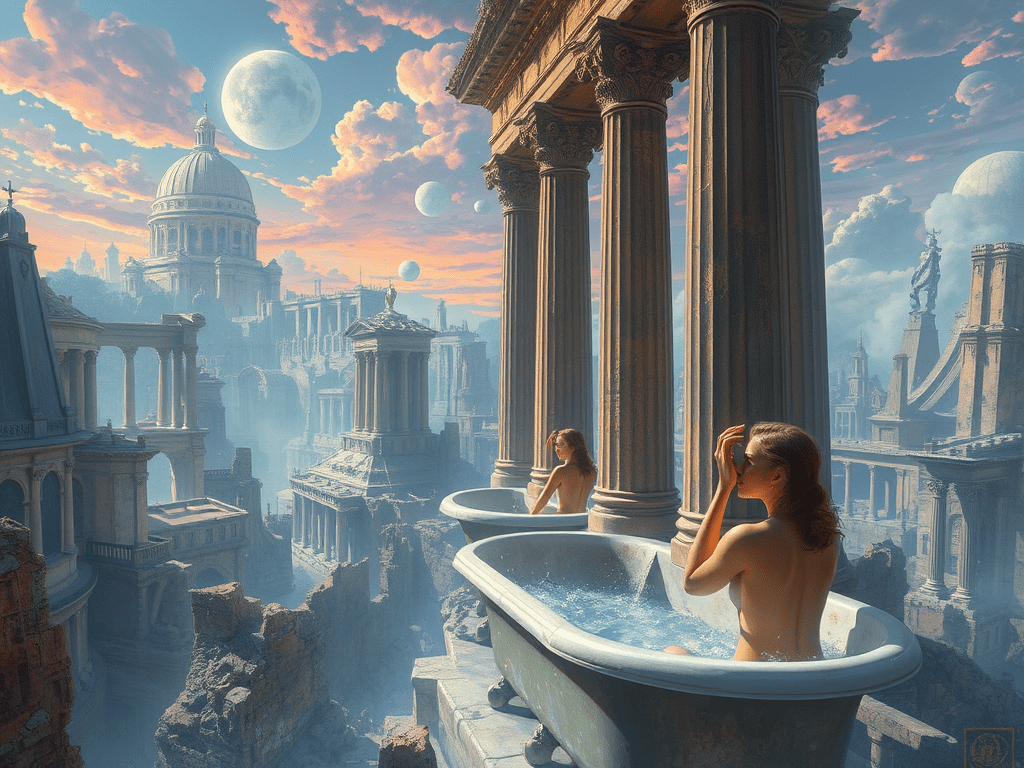
    For example, the invisible City of “Armilla has weathered earthquakes, catastrophes, corroded by termites, once deserted and re-inhabited. It cannot be called deserted since you are likely to glimpse a young woman, or many young women, slender, not tall of stature, luxuriating in the bathtubs or arching their backs under the showers suspended in the void, washing or drying or perfuming themselves, or combing their long hair at a mirror.”

    —If on arriving at Trude I had not read the city’s name written in big letters, I would have thought I was landing at the same airport from which I had taken off. . . . “You can resume your flight whenever you like,” they said to me, “but you will arrive at another Trude, absolutely the same, detail by detail. The world is covered by a sole Trude which does not begin and does not end. Only the name of the airport changes.”

    “Eutropia (a “trading city”) is made up of many cities, all but one of them empty, and its inhabitants periodically tire of their lives, their spouses, their work, and then move en masse to the next city, where they will have new mates, new houses, new jobs, new views from their windows, new friends, pastimes, and subjects of gossip. We learn further that, in spite of all this moving, nothing changes since, although different people are doing them, the same jobs are being done and, though new people are talking, the same things are being gossiped about.”

    From their conversations which began with signs and sounds unintelligible to both, to perfecting each other’s language, to the numbness of understanding through silence, Marco Polo the traveler and Kublai Khan the Emperor have sailed through a lot of cities. Kublai asked Marco: “You, who go about exploring and who see signs, can tell me toward which of these futures the favoring winds are driving us.” Already the Great Khan was leafing through his atlas, over the maps of the cities that menace in nightmares and maledictions: Enoch, Babylong, Yahooland, Butua, Brave New World.

    He continued: “It is all useless, if the last landing place can only be the infernal city, and it is there that, in ever-narrowing circles, the current is drawing us. “And Polo said: “The inferno of the living is not something that will be; if there is one, it is what is already here, the inferno where we live every day, that we form by being together. There are two ways to escape suffering it. The first is easy for many: accept the inferno and become so part of it that you can no longer see it. The second is risky and demands constant vigilance and apprehension: seek and learn to recognize who and what, amid the inferno, are not inferno, then make them endure, give them space.”

    I have had my fair share of cities. You leave a part of you every time you move on to a new destination, hoping you will find what you think you need! eventually, you might visit these cities at some point, hoping again to relive the life and time for a moment with a sense of detachment. Looking back I can see the trail I trod from the walkways in Cochin to Bangalore where the job hunters’ hopes, despair, and celebrations with friends were drenched in rum, to the long and sweltering bus trips to work in Chennai, to Chicago where everyone read something in the commuter trains and Fridays were an onslaught of adrenaline, to New York where you find countless people and cars travel all around you and yet you can listen to the tireless voice of a subway singer with his violin, to the laid back life in small town Pennsylvania and now in this aged, withering city of Philadelphia.

  • Pakistani States of Mind

    Pakistani States of Mind

    Picking up the pieces after the pause on Operation Sindoor is daunting, considering the high stakes Modi raised on Pakistan and India.

    The War

    For starters, a match-up or “notch up” of conventional warfare under the shadow of a nuclear disaster is an uneasy prospect, when the blowback will not stop at the border. The flight and downing of jets and exchange of projectiles were quality tests on leased Chinese weaponry and India’s assorted line-up of arms bought from the West, made-in-India variety, and some Russian, with an Indian recipe. The missiles targeted at India are named after the marauding medieval invaders from Central Asia and Turkey. India’s sudden acceptance of the call for ceasefire from Pakistan raises the question: Did they achieve their strategic goals, or is it a mere pause until the next attack by motivated terrorists? People living precarious lives along the border will tell us that war is no fun.

    The General in His Labyrinth

    The Pakistani General announced his firm belief in the two-nation theory just days before the brutal murder of innocent tourists from many states of mainland India by terrorists. He is undeterred by the sum of all failures thus far — the breaking away of Eastern Pakistan, the troubles in Baluchistan, a broken social fabric, and a failing economy, acknowledged safe haven for global terrorists. The only thing that stood between his army and the ultimate defeat of “infidels” was not having enough faith in the promise of their one God. He is a Hafiz who can recite the Quran to believe his messianic role in God’s call for Jihad upon infidels. Pakistani Generals are colorful Marquezian tin pot dictators with God as the alter ego with the smarts to find patrons for an endless supply of money and deadly weapons.

    Terrorist

    Terrorists are eternal opportunists. The plotters constantly observe, take notes, and plan the next raid. The poor, simple-minded expendables from the hinterlands of Punjab and tribal areas hide in plain sight in the company of motivated locals, clutching on to satellite phones until they receive the order to strike. They descend from the shadows after the holy month to perform their scripture-ordained duty to eliminate non-believers. The converted believers from the subcontinent owe it to their new faith to reconquer the land of Hind with a sword or bullet, for a place in paradise. They spared the lives of widows and daughters of the men they killed, as it was important for the killers to send a message of their merciful God and a warning to the leader of non-believers. The response was the retribution on behalf of the wronged women of a secular India. The Indian Army spokeswoman, Sophia Qureshi ironically wasn’t speaking on behalf of the lost tribe of Qureshi-s who lost the battle of Badr as written in the terrorists’ holy book.

    Chinese Quest

    China, in its bloody minded quest for silk routes, believes that its technology, often stolen from the West, and boundless production units can ride it’s fortune while the medieval wildlings are busy killing their brothers of old belief for now. The path to glory, a greater China, they believe, requires Islamic rage as fuel for human bombs to unleash on the inferior nations with minimum or no cost, while keeping the industrial-scale extermination and sometimes regeneration of deviants in Tibet and Xinjiang in a Han image. When finally the religious wars are over, the clashing armies will have annihilated each other to herald the greatest Chinese empire. This is not a dystopian dream if you consider the Chinese intent for granting nuclear technology to Pakistan. After all, some pieces of a disintegrated India with Chinese names are already in the official documents written in Mandarin, giving away hints of an impatient Chinese mind.

    The West

    Joseph Conrad’s sons in the West, in their infinite wisdom to civilize the dark continents, now want to prevent a holocaust among thoughtless, violent, and emotionally unbalanced brown people. Pakistan, as a gun for hire, is much cheaper than the Wagner brothers, with better training and the zeal of the faithful. If you doubt, just ask the Soviets. Why would they let it perish for the sake of the revival of Hindutva — pagans dreaming of hegemony. Empathizing and legitimizing their plight and grievances are the last things on their minds, whether liberal or conservative. The scatter-brained leader of the free world can only confuse the struggle as a thousand-year backyard brawl in which the prodigal son keeps returning with convictions of a new faith, who is convinced of the ultimate triumph, will always end up making the Dharmic elder look bad!!

    Colonial State

    Pakistan is the idea of renaissance men haunted by colonial nostalgia. It is the Muslim version of Old India, where you find the progeny of feudal Zamindars and merchants with old money from Central India, Punjabi bureaucrats and men in uniform from British India, and the poor but fanatically faithful migrants from the mainland like Uttar Pradesh and Bihar. The feudal lords became the political class, diplomats and bureaucrats, and servicemen turned into business conglomerates moonlighting as the military, and the peasants filled madrasas that became recruiting centers for the Lashkars. Everybody else migrated to the West with their bounty or hopped onto a dhow to the Middle East for menial jobs or even to beg.

    Indian State

    The Idea of India is mankind’s longest project. Kashmir, with a majority of citizens believing in Islam, is not an anomaly. There are a million Kashmirs — big and small — all across India, thriving in a democracy, however chaotic, that is growing economically and technologically while struggling with their identity to find a place in it, and some even moving past the debate to believe in the identity as Indian in a democracy trumping the rest. The Congress Party, which led the non-violent resistance for freedom, made a Faustian bargain with the medieval-minded section of minority for power. The right-wing BJP is living on the edge to retain it.

    The cacophony

    The world has become a babel! There is a no-holds-barred scrap in the corporate and social media pushing narratives. While in Pakistan, even the liberal commenters have gone nuclear, turning into Army spokesmen and competing with Jehadis for bluster. Neutral commentators, trapped in nostalgia, replay tired narratives like old VHS tapes. Truth dies when war begins.