“There will be time to murder and create,
And time for all the works and days of hands
That lift and drop a question on your plate;
Time for you and time for me,
And time yet for a hundred indecisions,
And for a hundred visions and revisions”
–T.S.Eliot (Love song of J. Alfred Prufrock)
Andrei Tarkovsky was a poet. But he chose cinema for his medium. Every film of his had been a quest for Andrei’s identity as an artist. He believed no true artist had ever lived in an ideal world and the issues of the real world were the very impurity for the chemistry of creativity. He further believed that the same artist was challenged by the concept of time, more so for a director.
The director is at pains to capture the fleeting moments of vision and sculpt them with structure, images and metaphors. The linear narrative is an impediment to poetic expression and the shining metaphors and visions that Andrei so dearly wanted us to see might just vanish. He is also worried about characters and their experience in the movie, taking over the experience of cinema and channels of communication between the connoisseur-audience and the artist.
I revisited Andrei’s Andrei Rublev(1966) last week, one of the best films ever. It recounts the struggles of Andrei Rublev, a 15th century icon painter in Russia who lived through a brutal and volatile period of history with marauding Tartars and treacherous princedom. The film is divided into seven chapters with a prologue and an epilogue, revealing a deep rumination over the moral, ethical and artistic dilemmas faced by Rublev and they are narrated in a heap of metaphors, conversations, incomplete montage of ideas, fragmented memories and images conjured up from the landscape. There is no one point of view, but an orchestration of everything mentioned above. I just want to discuss briefly the last chapter which I felt singularly represented the cosmic-onomics of Tarkovsky’s world.
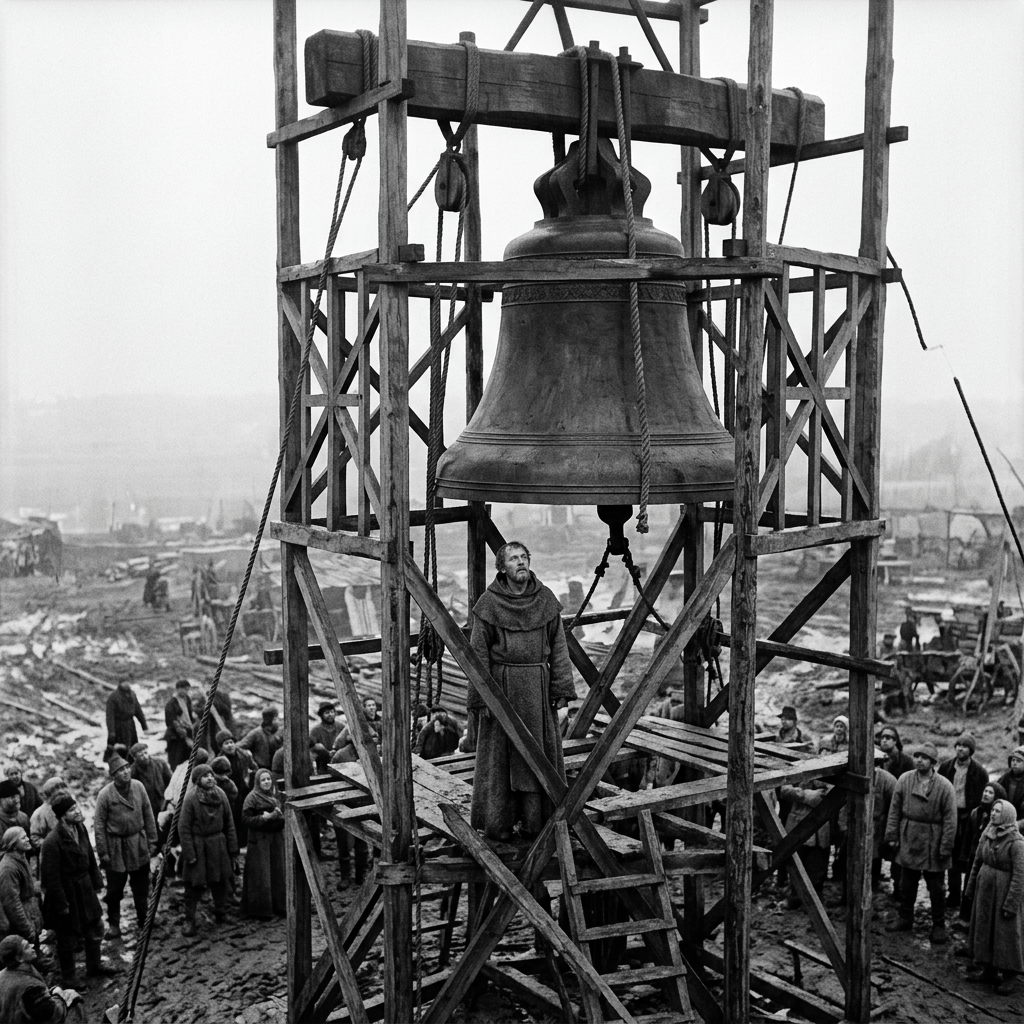
It is titled “The Bell”. Andrei Rublev, under a vow of silence and overwhelmed by his self-doubts as an artist and atonement as a human being comes upon the casting of a great bell. The bellmaker has died, but his son, Boriska, claims his father ‘passed on’ the secret of the bell to him alone. He has inherited his father’s work. He was threatened of grave consequence should he fail. Amid confusion, rain and treachery the bell is finally cast and raised.
During this cacophony, the monk Kirill, Rublev’s envious peer has a reckoning with him, accusing him of wasteful inactivity, of ‘taking his great talent to the grave’. As the bell at last rings out, Boriska, hysterical and exhausted, collapses, confessing that his father had not passed on his secret after all. The son had proceeded on faith, feeling and madness alone.
This is the revelation Rublev was looking for. He tells Boriska that they should go to the Trinity monastery (the fresco project which Rublev earlier abandoned) together where Rublev will paint and Boriska will cast bells. The two men embrace as the camera pans past them over burning logs and dying embers, as the black and white images slowly dissolve into color fragments of Rublev’s frescoes.
Out of the ash-nothingness arises a poetic vision. A deep meditation on the significance of inner conflicts, realization and triumph of an artist’s will over the senseless flight of time.
Andrei was the true poet of cinema who had a great sense of time.