Posts

  • In Light of India – II

    In Light of India – II

    Rama & Allah

    Octavio Paz is incisive when he speaks about the coexistence of the two religions that are strikingly at extremes – one the richest and most varied form of polytheism and the other, the strictest and most uncompromising form of monotheism. He observes how the two communities retained their identities without fusing and how the Muslim invasion happened in India long after the decline of Islamic civilization itself. He also notes that Sufi mysticism triggered a literary tradition in northern India, just as the Bhakti movement drawing on the Sufi influences sought to challenge orthodox Hinduism.

    “Kabir is the son of Allah and Rama. He is my Guru, he is my pir…Tagore translated Kabir’s poems because, in Kabir’s Unitarian vision, he had seen a failed promise of what India could have become.”

    Paz highlights the contributions of Akbar and Dara Shikoh. Dara’s translation of translation of Upanishads into Persian eventually ended up in Schopenhauer’s desk and through him, inspire Nietzsche and Emerson. Schopenhauer had called all his poodles as Atma – Soul. However, the period of enlightenment was followed by the dark years of Aurangzeb who according to Paz deepened the fault lines between Hindus and Muslims – divisions that echoed across centuries. He also noted that the East India Company had rarely interfered with the social fabric or religious identities of Indians, they instead exploited the divisions for profit and deflect conflicts away from colonial masters. Ironically, the notion of nationhood was an idea given to the Indians by the same foreign rulers.


    Another striking aspect of the book is Paz’s take on the caste system. Often condemned—and sometimes confused with racism—caste is, for Paz, also a way to understand the Hindu social fabric in relation to its philosophy of Karma. He acknowledges the critics of untouchability, but warns those who recoil at the word “caste” not to overlook the ancient hypotheses of cosmic order and the doctrine of Maya — the illusion of time – which assures that even suffering souls will eventually be freed through the cycles of birth and death.

    Modern Indian History

    From religion and social philosophy, Paz turns to the figures of modern Indian history: Raja Ram Mohan Roy, Subhash Bose, Gandhi, Nehru, V.K. Krishna Menon, M.N. Roy. Of these Menon and Roy drew his sharpest attention. According to Paz, Menon was a malignant influence on Nehru who ultimately proved to be a “fatal union” for Nehru.


    “Menon was an arrogant and intelligent man, but, as so often happens with the proud, he was not the master of his own ideas: he was possessed by them. Nehru was never able to recuperate from the disaster of his foreign policy.”


    By contrast, Paz’s account of M.N. Roy is replete with fascination and respect. Reading Paz’s account of Roy’s many political transformations, especially with the benefit of hindsight that we have now, one couldn’t but admire Paz’s prescient grasp of political history and recognition of Roy as perhaps the only genuine political mind to have emerged from India to leave a a lasting impact on International politics.


    Roy’s journey was extraordinary: an extreme nationalist inspired by Marx, pursued closely by British Intelligence, he fled to Chicago, and later during the First World War sought asylum in Mexico. There, he helped found the Communist Party. Impressed by Roy’s activities and skills, Lenin invited him to participate in the Third International and made him its agent in Central Asia and China. Yet Roy eventually broke with both the Comintern and Marxism itself. Returning to India, he fought for Independence, and spent years in Jail, and during the Second World War supported the Allies, recognizing the threat of Nazism posed as far greater than colonialism, and rejecting to take sides with either Gandhi or Subhash Bose.

    After the war, convinced that the totalitarian system founded by Lenin and Bolsheviks was a disaster, he formulated Radical humanism as a revolutionary response to the failure of socialism. His ideas may not have endured, yet Paz’s brilliant portrait of M.N. Roy- spare, brilliant and perceptive – captures a political genius in a few strokes that might not be found in Kosambi’s tomes of political history.

  • In Light of India – Part I

    In Light of India – Part I

    It rained.

    The hour is an enormous eye.

    Inside it, we come and go like reflections.

    The river of music

    Enters my blood.

    If I say body, it answers wind.

    If I say earth, it answers where?

    The world, a double blossom, opens:
    Sadness of having come,
    Joy of being here.

    I walk lost in my own center
    .

    The essence of Octavio Paz is captured in the short poem: existence as a reflection, time as mystery and the world as duality. As a reader, I couldn’t help but notice Paz’s polemics on existential and reflective differences between civilizations and how oriental was time as a concept in his poems and other writings. His inimical vision of history as an imagination of time had parallels in ancient Indian philosophies. Today, he is being rediscovered not only as a poet of great vision, but also for his scathing criticism of modern democracies for their development model and establishments of greed.

    In Labyrinth of Solitude, Paz has argued that the Mexican civilization had come to a stasis, abandoning its glorious past to withdraw inwardly and self-deprecatingly looked up to its neighbor in the north. It was fairly easy to recognize Octavio Paz’s affinities and insights in the book, In Light of India.

    As anyone who visited India would vouch, India gets through your senses much before your brain begins to register all your preconceived notions of her. You will realize that the teeming reality around you will soon blur its contour to leave you in a daze. Paz spoke about the India he encountered in the bustling streets of Bombay of yore:

    “I put my things in the closet (at Hotel Taj Mahal), bathed quickly, and put on a white shirt. I ran down the stairs and plunged into the streets. There, awaiting me, was an unimagined reality:

    Waves of heat; huge grey and red buildings, a Victorian London growing among palm trees and banyans like a recurrent nightmare, leprous walls, wide and beautiful avenues, huge unfamiliar trees, stinking alleyways,

    Torrents of cars, people coming and going, rivers of bicycles,

    in the doorway of a shack, watching everyone with indifference an old man with a noble face,

    Another beggar, four half-naked would-be saints daubed with paint, red betel stains on the sidewalk,

    Turning the corner, the apparition of a girl like a half-opened flower,

    Stalls selling coconuts and slices of pineapple, ragged vagrants with no job and no luck, a gang of adolescents like an escaping herd of deer,

    A magnificent eucalyptus in the desolation of a garbage dump, an enormous billboard in an empty lot with a picture of a movie star,

    More decrepit walls, whitewashed walls covered with political slogans written in red and black letters I couldn’t read,

    As night fell I returned to my hotel, exhausted…but my curiosity was greater than my fatigue. I went out again into the city. I found many white bundles on the sidewalks: men and women with no home…I saw monsters and was blinded by the flashes of beauty. I strolled through infamous alleyways and stared at the bordellos and little shops: painted prostitutes and transvestites with glass beads and loud skirts. I wandered toward Malabar Hill and its serene gardens.”

    Paz goes back to his hotel but decides to take another walk toward the coast and there he tries to take inventory of all that he has seen, heard, smelled, and felt. He thought of dizziness, horror, stupor, astonishment, joy, enthusiasm, nausea, and an inescapable attraction to explain his state of mind as a “young barbarian poet”.

    If we chop and change some images here and there, contemporary India despite the double-digit economic growth would not be too far away. Paz gets down parsing his newly found exhilaration in the rest of the book which took decades to complete. One doesn’t read Octavio Paz as an academic exercise. One reads him for his insights, provocations and his attempts to engage civilizations in a constant dialogue.

    Even in the opening chapter, Paz reveals his sense of history and uncanny gift for archetypes. According to him, wandering in New Delhi is like passing through the pages of Victor Hugo, Walter Scott, or Alexander Dumas. For him, it was the most ancient of cities – Indraprastha of the epic Mahabharatha where legendary battles of power and ethics played out; and also the city of serene Muslim mausoleums. He writes about the unforgettable moment when he wandered into a tiny empty mosque whose walls were made of marble and inscribed with passages from the Qur’an. Above, the blue of an impassive and benevolent sky was only interrupted, from time to time, by a flock of green parakeets. He stayed there for hours. According to him, it was a vision of the infinite in the blue rectangle of an unbroken sky.

    Years later, Paz would return as the ambassador to India, travelling across the country, collaborating with poets Agyey and Shrikant Verma, and writing East Slope, a collection of poems on Indian themes. He would also talk about his experiments in collaborative poetry with Agyey and Shrikant Verma on Friendship. At Rajiv Gandhi’s behest, he gave a Lecture on India, which he revisited later to write In Light of India. The book makes no sweeping claim of anything in particular, yet it remains a treasure for its insights and tenacity to seek answers in an unfinished quest to make sense of civilizations in conversation.

  • Life A User’s Manual

    Life A User’s Manual

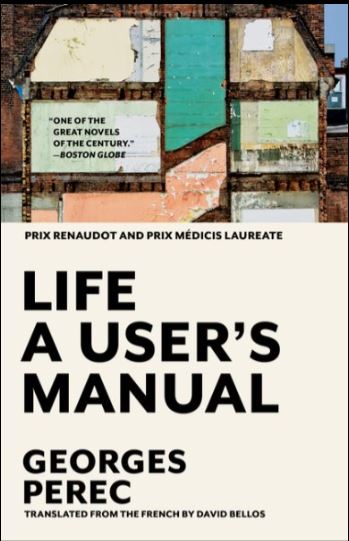
    I read Georges Perec’s Life: A User’s Manual when I was a master’s student in physics. At the time, I was toiling through books and lectures on classical and quantum mechanics—essentially, working for a degree. The Lagrangian and Hamiltonian equations, particle theories, their graduation to quantum physics, and further into Schrödinger and Heisenberg’s formulations, all passed by in a haze.

    I was grappling with the concept of constraints in Lagrangian mechanics when I opened Perec’s preface. In it, he forewarned the reader about the games and devices he had woven into his novel. Although he wrote the book to be eminently readable, he made no bones about the underlying rigor of its construction: the sequence of chapters follows the algorithm of a chess game; jigsaw puzzles, crosswords, and probabilistic formulas organize the literary elements—objects, characters, situations, allusions, and quotations—into a deliberate order; even the indexing of its ninety-nine chapters is modeled after Dewey. It was the mind of an architect at work—focused, meticulous, and simultaneously non-committal about the grandeur of the project, stoic about its futility, and dispassionately observant of life’s intricate goings-on.

    Lagrange essentially said that imposing constraints on a system is another way of stating that forces are present in the problem which cannot be specified directly, but whose effects on motion are known. Perec took this principle into literature—adopting constraints as an empirical approach to writing and, by extension, to reading.

    Perec was part of the Ouvroir de Littérature Potentielle (Oulipo) group, devoted to the study and invention of literary forms. Under the leadership of Raymond Queneau and François Le Lionnais, the Oulipo worked—and still works—to identify and revive neglected forms, while also devising new ones based on rigorous formal constraints. One member famously defined the group, tongue firmly in cheek: “Oulipians: Rats who must build the labyrinth from which they propose to escape.” Perec found a home here, among writers like Jacques Roubaud, Harry Mathews, Italo Calvino, and Marcel Bénabou.

    Life: A User’s Manual tells the story of a ten-story building at the fictional 11, rue Simon-Crubellier in Paris, meticulously describing its interior and the lives of its residents—179 stories in all. Their order is determined by a famous chess problem: visiting every square on a board using only the knight’s move. Once the constraints are set, Perec emerges as anything but a cold formalist—his affection for the characters and their idiosyncrasies is unmistakable. The stories stir wonder, laughter, and reflection, as they reinvent genres—romance, drama, detective tale, adventure, murder mystery—through restaurateurs, mediums, cyclists, antique dealers, and pious widows.

    Some examples:
    – A trapeze artist’s swansong at the circus—an impossible feat that ends in his death.
    – An archaeologist on the Nile trying to rescue a German girl from a harem.
    – A judge’s wife whose thrilling thefts lead to hard labor, ending as a bag lady on a park bench.
    – A murder mystery in which the protagonist adopts the Monte Carlo theory of probability to find his wife’s and daughter’s killer—only to narrowly miss encountering him.
    – A prophecy that shadows generations of a tragedy-stricken family, glimpsed only in a brief visit to an empty apartment.

    These stories leave little doubt about Perec’s storytelling gift. Beneath them all runs a subtle negotiation between writer and reader, with the big picture always in the backdrop. That is where Perec introduces his central figures: Bartlebooth, the millionaire maverick painter; Gaspard Winckler, his assistant; and Valène, the concierge who narrates this intricate web of stories.

    Bartlebooth’s project is monumental: over twenty years, he will travel the world painting 500 watercolors of different harbors. Every other week, a painting is sent to Winckler, who mounts it on wood and cuts it into a 750-piece jigsaw puzzle. Once Bartlebooth returns, he will spend another twenty years reassembling the puzzles, then return each to its original harbor, where it will be washed clean, leaving a blank sheet—the beginning and end coinciding. But things do not go as planned.

    To avenge twenty years of “pointless” work, Winckler begins making the puzzles increasingly difficult. Almost blind, Bartlebooth dies while attempting the 439th puzzle. Perec’s final paragraph captures the irony:

    “It is the twenty-third of June nineteen seventy-five, and it is eight o’clock in the evening. Seated at his jigsaw puzzle, Bartlebooth has just died. On the tablecloth, somewhere in the crepuscular sky of the four hundred and thirty-ninth puzzle, the black hole of the sole piece not yet filled in has the almost perfect shape of an X. But the ironic thing, which could have been foreseen long ago, is that the piece the dead man holds between his fingers is shaped like a W.”

    Winckler, dead two years earlier, has triumphed—but it is a meaningless triumph.

    In a single paragraph, Perec captures the grand project of life, the inherent meaninglessness of human effort, and the role of chance in undoing even the most carefully designed schemes. Our lives are shaped by innumerable constraints—social, ethical, moral, physical, biological—some accepted, some resisted—while the interplay of chaos and order goes mostly unnoticed.

    For someone who once wrote a novel entirely without the letter e, and as a leading figure of the Oulipo movement, this feels like a summit. In it, you sense the shadow of Joyce, Borges, Calvino, Flaubert, and Kafka—but also something uniquely Perec’s own.

    For now, I have nothing more to say. Go read it—the book belongs to you, my dear reader.

  • Song of seasons

    Song of seasons

    The songs of seasons

    May:

    The Country road lay like a tamed snake, brown and parched, heaving and teary-eyed. Sunshine raced to distant fields like wildfire and bounced off broken heaps of images. The wasteland subsisted on dried tuber and the wisdom of defiant dry bones of the river bed. The fire sermon was delivered in May.

    The ceiling fan in your room is a bit of schizophrenic, besides being old and cranky, and you lie in your bed, etherized; while the vagaries of Summer and memories melted in crimson flames. 1

    June:

    Monsoon arrived when the dark clouds with lightning streaks broke the skies’ boundary. The air grew dense. It wafted the scent of impregnated soil. Trade winds came and then came meghmalhar. An alaap began in vilambit interval swelled on to madhyam and culminated in an endless dhrut khayaal. A million drops of rain fell on the remains of life on Earth. The puddles, rivulets, streams, rivers, lagoons, and whirlpools flowed, swollen by a mass of turbid waters rushed with impetuous haste towards the seas, felling trees and deluge-struck mortals all around on their banks and washed them to a timeless shore.2

    September:

    A sudden light shower in the morning, left the yard exhilarated and let it regain composure. The laughter and mirth from the living room grew with sunshine. Today is Onam. There is weightlessness in reunion and barricading time to slip any further. Spring is now and hope is in the moment.

    November:

    Autumn is too short to pause and ruminate over the blinding beauty of orange evenings and golden yellow leaves. And yet one ruminates, invariably. In one of these autumns, Lorca3 moved to New York while it ushered in the great depression. The autumnal marvels of his Granada, its solitary rose breath and its leaves, reflections of pillars and arabesques in the pools, the splashing fountains and the profusion of myrtle and pomegranate – were all estranged, now. The loss of November!

    January:

    Winter can wreck your senses, nudge them into frigidity, and remind you that you live in a world of morbid nerves, clear and cold as ice. The cold winds blowing across the snowy landscape can bring in the visage of death and a possibility of enlightenment. You may even gain the courage to glance at the white emptiness that lay beyond the limits of your eyes and the moonbeam’s icy glitter. The winter in your sense organs would tell you that you have always been in a snowy country, alone and unable to speak.4

    Note: The color and sound of the seasons have been inspired by the following writers.

    1. Thomas Stearns Eliot (The Wasteland) 2. Mahakavi Kalidasan (Ritusamharam) 3. Federico Garcia Lorca (Poems in Newyork) 4. Yasunari Kawabata (Snow Country)

  • Hope Springs Eternal

    Hope Springs Eternal

    My aunt’s husband left the city of Kochi (Kerala, India) after retiring as a Deputy Revenue Officer. He relocated his wife, and children, except for the oldest daughter finishing college, to Chelakkara in the early seventies, a sparsely populated boondock northwest of Thrissur. After a day-long journey by bus, I had to walk for miles on a rough, winding road flanked by undulating paddy fields on either side until it became an unpaved but equally wide rugged rural pathway, leading to the gate bearing their family name inscribed.

    The house stood in the middle of several acres of land with a bamboo fence. The yard was filled with various fruit trees – many mangoes, jackfruit, guava, gooseberry, cashew apples, and Sapodillas. I was told my uncle even attempted farming paddy once. The original owner of the land was his neighbor. The house also had a cavernous well with nothing but rock at the bottom which my cousin wistfully described as a money pit where his father threw away a fortune over several years hoping for a spring. Now it was just a reservoir for rainwater that dries up in the summer for snakes to snuggle in the damp and shade.

    The house was spacious with a room full of antique cupboards where I found a treasure of his collection of books and audio cassettes. In a chest, I found an official invitation to the first show in Shenoy’s theater in Kochi for its grand opening which someone kept as a souvenir. Uncle had diaries with quotations from and annotations on Malayalam poets, mostly by G. Shankara Kuruppu and Vallathol. It also had notes and tips on farming. I realized the books on Physics and World literature belonged to his brother who died young when he was a lecturer at Brennen College. The complete collection of Yesudas’s Hindi Songs too was his legacy. I never met him. I saw my uncle only twice, of which the second meeting was when I traveled for almost all day in several buses with my parents for his funeral. He visited us a few months earlier to seek my parent’s help to dissuade his younger son from marrying a young girl he met near the dorm, having decided to drop out of college.

    I observed none of my cousins were interested in the books or farming. No one else studied beyond High school or basic trade school while their cousins in Kochi were known for academic excellence including post-doctoral degrees. The older daughter got a job in Government, married, and continued to live in Kochi. They sold the property by the end of 1999 back to the neighbor for a price. Until her last, my Aunt, who retired as a teacher ages ago, lived with the younger son who became a primary school teacher in a small town closer to Kochi. He divorced his first love and is separated from second wife. The other children too found their place now closer to Kochi even though they are still a few hours away.

    I remember watching a French film starring Gerard Depardieu – Jean De Florette (1986). Depardieu played the character of Jean, the Tax Collector and son of Florette who returns with his wife and daughter to the village to claim the land he inherited from his mother to begin the life of a farmer. Ugolin, his neighbor and local farmer who fought with Jean’s uncle earlier for not selling the land, realized that Jean too did not intend to sell. Despite all the efforts to make Jean’s life hell, Ugolin couldn’t make Jean sell his house. He along with an accomplice blocked the spring that was the only source of water forcing Jean to begin digging a well to collect rainwater at least as long as that lasts. Unfortunately while trying to blast open the well, Jean gets hit by a rock and dies. Jean’s distraught and orphaned family sells the house to Ugolin and leaves the village. Soon after, Ugolin unblocks the spring and begins to make a good profit.

  • The Great Gatsby

    F, Scott Fitzgerald’s The Great Gatsby is a short, dense novel. He is not one of my usual choices of writers to pick up and read. But the flair and taut writing had me hooked. His exquisite craft in narrating the Long Island soirees from the Jazz Age where midwesterners came to claim the American dream amid their insecurities about displacement by inferior races, nouveau-riche threatening class barriers and traditional social order, women becoming the co-conspirators to relegate themselves to “beautiful little fools” of their possessors’ social standing – weaving layers of socio-political commentary.

    Nick Carraway, the narrator of the story – a mid-westerner presents an empathetic portrayal of Gatsby, who, in turn, was ingratiating himself into Nick’s life to get close to Daisy Buchanan, Gatsby’s long-lost love. He takes time to shed light on the main characters – Tom Buchanan, the rich and imperious former polo player and Yale alumnus, whom Daisy reluctantly married when Gatsby, son of a poor Lutheran farmer, left town to war with the world and earn enough to marry her. Daisy Buchanan is Nick’s cousin, who grew up in a wealthy family, is a victim and sustainer of the class system of old money as she tolerated Tom’s adultery, condoned racist rants, and finally abandoned Gatsby to his fate, notwithstanding her unabashed love and attraction for him.

    Gatsby conquered the world with the best of American traditions – bootlegging during the prohibition era, insider trading, and other illegal activities, only to settle down near Nick’s house. He ran parties all night without taking part in them, and used them only as a ruse to get close to Daisy. Having Daisy invited over to Nick’s house, Gatsby asked her to play the piano despite her protests about being out of practice. He was reliving the enchantment he lost five years ago, which Nick observed through the bewilderment on Gatsby’s face when Daisy “tumbled short of his dreams-not through her fault, but because of the colossal vitality of his illusion”. Nick went out of the room, leaving them to be “possessed by intense life”.

    Tom punctured Gatsby’s illusion with the help of a private detective and warned Daisy of the source of his wealth. Their confrontation led to tragedy when Daisy, while driving back home, hit Tom’s lover accidentally and ran away. Gatsby tried to protect her as he hid the car in his garage and later kept a night vigil in the garden to see if Daisy was safe in her room with the lights off.  Tom, after a while, reveals that he told the heartbroken widower of his lover, Wilson, that the car that killed her belonged to Gatsby. Wilson committed suicide after shooting Gatsby. Nick finally meets Mr. Gatz, Gatsby’s dog-tired father, as they attend the loneliest funeral sans the sounds of Jazz and the flock of humans.

    Nick, too, leaves New York, brooding over the old, unknown world, and he thought how Gatsby “picked out the green light from Daisy’s dock”. He didn’t realize that the dream he thought so real in his grasp was already behind him. Fitzgerald finishes with a flourish on our collective American dream etched on the Statue of Liberty:

    “Gatsby believed in the green light, the orgastic future that year by year recedes before us. It eluded us then, but that’s no matter – tomorrow we will run faster, stretch out our arms farther…. And one fine morning……

      So we beat on, boats against the current, borne back ceaselessly into the past.”

  • Crowd, Power and Space

    Crowd, Power and Spaces

    Israel is up against a triple crowd surging in three-dimensional space doubling down on its maximalist demands to find some ways to vanish from the center of their universe —morally, militarily, and symbolically. It’s not merely a military conflict; it’s a struggle over legitimacy, truth, and the right to exist as a liberal democracy amid ideological absolutism.

    The First Crowd

    Having raided across the lines of enemy territory, the savage plunderers chosen by the tribal gods exacted untold trauma and brought enough prisoners. They formed the first crowd to do the job of baiting the armed foes coming in with survivors’ guilt and irrational haste to the arena. Physically they have surrounded themselves with concentric circles of prisoners and people from their own tribe.

    The Second crowd

    Both prisoners and unarmed civilians form the firewall even the cruelest dictator would dream about. They are the crowds of lament. The worse their plight becomes, the enemy’s will to fight worsens. The terrorists wish nothing but the worst inflicted upon them and suffer immeasurably from the fury of retribution. It is indeed heartbreaking to watch death and destruction in the wake of an apocalypse and a densely packed city laid asunder.

    The Third crowd

    The marching crowds in the world’s cities and schools demanding complete surrender to what they will ask next is possibly the most dangerous of the three. Champions of ideologies – both religious and liberal kind found an intersection in their disdain for democracy and lust for power to close down avenues for dialogue, coexistence, and peace. Their politics of grievance gives them the opportunity to destabilize the world order and hope for another Iran or a resurrection of Soviet Gulags out of the rubble. They believe the union outmaneuvers reason and logic with intentionally loud and prosaic phrases like apartheid, occupation, open prison, etc., while promising that the crowd will overrun the few million Jewish survivors shortly, notwithstanding their deadly weapons of mass destruction. They do not have the patience to listen to the stories from the holocaust.

    Three-dimensional space

    The terrorists spent their entire fortune building a metro of tunnels under their city of squalor and suffering. They crawl out of the holes to inflict pain on others or draw them into the dark traps of death.

    The population living above ground in the ghastly city is held hostage to the regime of terror while being the willing and fertile source to recruit their rank and file.

    The sympathizers all over the world occupy spaces in the multiverse of the internet, town squares, the labyrinth of universities, and ghettoes where immigrants import unsolvable animus from the dark ages.

  • Israel and the Baiting Crowd

    When mythology becomes ideology and ideology becomes execution, a darker logic takes hold.

    The blood-curdling acts of cruelty unleashed on civilians in their homes—targeted killings, hostage-taking, and indiscriminate violence—mark a terrifying regression into primal forms of conflict. These actions, as witnessed in recent Hamas attacks, go far beyond political grievance or tactical warfare. They reflect an ideological totality rooted in an unredeemable vision of the enemy. In such a vision, there is no room for coexistence—only elimination.

    Radical Islamic terrorism, such as that espoused by Hamas, draws its fervor from literalist interpretations of religious texts. These scriptures, while diverse and often poetic, are seized upon by extremists to construct closed, absolutist narratives—myths that sanctify violence and demonize the other.

    Yuval Harari, in Sapiens, argues that Homo sapiens rose to dominance not through brute strength but through the unique ability to share stories—fictional narratives that enabled mass cooperation. Religion, like law and nationalism, is among the most enduring of these inventions. These stories—what Harari calls “gossip”—bind individuals into communities. But when transformed into dogma and wrapped in divine authority, they can become weapons.

    This is the foundation of radical Islamist ideology: where myth becomes command, and faith becomes justification for violence. The enemy is no longer just a political adversary, but a moral and ontological threat whose very existence defiles the sacred narrative. The religious story becomes a call to arms.

    The execution of this call finds disturbing resonance in Elias Canetti’s Crowd and Power. Canetti describes the “baiting crowd” as the most ancient and primal form of collective action. It forms around a quickly attainable goal: a victim, clearly marked, defenseless, destined. The crowd moves with single-minded purpose. Each individual strikes a blow, not out of strategy, but out of ritual. The killing is both symbolic and literal—meant to rid the group of its own fear, its own death. Yet paradoxically, after the execution, the crowd disperses, more anxious and fractured than before.

    This, then, is the horrifying convergence: Harari’s myth-making meets Canetti’s crowd impulse. The ideology draws legitimacy from scripture, and the crowd, believing in that narrative, acts it out with blood-soaked devotion.

    In the ideology of Hamas, we see this pattern laid bare. A theology that lionizes martyrdom and promises divine reward collides with a political fantasy of erasing Israel. The result is a mobilized crowd willing to kill and be killed—not as soldiers, but as believers acting out a sacred script.

    What makes this moment more dangerous is the global amplification of this narrative. Despite Hamas’s use of civilians as human shields, its genocidal charter, and its rejection of compromise, there is a rush—in parts of the Islamic world and among segments of the global left—to frame its actions as resistance rather than terror. Israel’s right to self-defense is questioned more than Hamas’s right to exist.

    This signals a disturbing moral inversion. Those who slaughter in the name of God are humanized. Those who retaliate to protect civilians are pathologized. The baiting crowd is no longer confined to streets or battlefields. It has gone virtual, networked, and transnational—spurred on by ideology, grievance, and a prophetic sense of historical destiny.

    Harari ends Sapiens with a warning: that humanity, having acquired godlike technologies, remains dangerously guided by prehistoric instincts. Unless we interrogate the stories we believe in—how they form, how they justify violence, how they sanctify crowds—we risk returning to the oldest form of brutality: the hunting pack, now cloaked in scripture and broadcast to billions.

  • Atlantis, the lost island of childhood

    Atlantis, the lost island of childhood

    In the beginning, as far as I can remember, the lush green strip of land was ensconced by the Arabian Sea and a thin river line that was lost into an estuary. A billion species of life thrived in the tiny whirlpools. Sunshine fell on the flowing waters in every fissure. When it rained, the natives who lived in the shanty could see the silver lines of thunder afar and scampered to bring the cows and kids home from the field and the wantons of country roads. The wind wove a symphony across the countless coconut trees that arched over the white and golden sand dunes. Folks called the place – an island, with no name, perhaps to remind the sovereignty of the land that leant over the timeless ebb and flow of the ocean.

    I used to visit my grandparents’ house during our summer vacations. We, the boys from the city found our space and deflated the overcrowded time from our senses on the island. The travel included trekking by bus and ferry boats, finally walking more than a mile passing paddy fields and country roads paved with soft red soil and sand until we reach the Riverbend and holler for the ferry as we soak in the wet breeze wiping away the last trace of fatigue.

    The folks in the house had to paddle across the river for everything that they ever needed, and every household had its own boats. The nights were dense and we could see each other’s faces in sepia sitting across the kerosene lamps for dinner. Eight siblings and dozens of grandkids thronged the spacious and benevolent home during those unforgettable times. If I close my eyes, I can still see the shimmering torch lights of solitary pedestrians on those rugged paths by the river and fisher folks rowing by.

    It must be right after the famine in the forties, my grandfather and his brothers left their misery to follow a dream of a piece of land to call their own. I never asked him to chronicle the events or timeline. They had nothing and everything to fight for. The island was waiting for them to build the Promised Land, and the earth was nubile and feisty. He had plowed his way and unleashed the raw power of farmers and fishermen to build the house, cultivate the land and build boats to fish with a lot of camaraderie with his brothers and natives.

    As kids, we spent the summer vacations in exhilaration, playing on top of the piles of coconuts and grains; canoeing up and down streams; gathering around the table where everyone assembles for dinner and woke up with the roar of waves retreating from the back of the house every morning. My grandfather looked like Odysseus who just came home to Ithaca, having done his journey.

    I spent a lot of time with him listening to his monologues on movies he watched from the country movie theatre or the quality of carpenters who worked on his boats. He also spoke about the murderous sea storms and fights among fisher folks who haunted the evening taverns with a kind of defiant nonchalance. He was Hemingway’s Santiago who came from the sea with the biggest fish I could ever imagine sculling the boat from the horizon, but he was not weary.

    I never asked my grandfather about his journey, rather I was basking in his days of glory. But then things took a different course ever since he folded himself into retirement. My aunts were all married off and had more significant issues in life and kids to gather around, my uncles vanished into the crowds in different parts of India and outside in search of jobs.

    Society itself was undergoing the customary changes as always has been. The deluge of foreign money and pomp of Gulf country residents rolled over the spirit of the land. The old house was abandoned and the grandparents were transplanted to the new home built near the highway and surrounded by walls. The rain, the wind, the undulating expanse of coconut trees, and the waves from the ocean were shut out for the rest of their lives.

    Grandma died first and Grandfather followed her soon. Even the new house looks so old now, occupied now by one of my uncles. He might probably visit once in a while from Dubai where he found a job. The dilapidated and moth-ridden old house bid the last moments of its existence before it was smashed down, probably to build a concrete warehouse for fertilizers. Now that the island has been named and electrified.

    Atlantis, the lost continent is considered to be the source of all Religion, all Science, and all races and civilizations. As we enter the third millennium, the Age of Aquarius its discovery is deemed to cause a major revolution in our view of the world and of both our future and past. I found my Atlantis on that island a while ago when I was a kid. The hearts and minds of the dwellers who built a brave new world over there, though lost, would still speak to you if you listen. That this world can still be mysterious and beautiful if you can spare a moment to grasp.

  • Summer in Barcelona

    Carthaginians found Barcelona along the coast of Catalonia. Romans, Visigoths, Umayyads, and even Plague laid siege on the city cutting down the population in regular intervals. The port city was overrun by people living in filth and squalor with disease outbreaks in the industrial age during the mid-1850s. Constricted by the medieval wall surrounding the city, the citizens began to demolish centuries-old gridlocks and unite the old town and surrounding villages.

    City of Memory and Dreams

    Civil engineers and architects began to dream of wider sunlit streets, free-flowing traffic, tall gothic structures, and narrow walking streets forming perfect geometric shapes crisscrossing the city at the foot of the Serra de Collserola mountain range. Ildefonse Cerda, the civil engineer conjured grid patterns, long straight streets, wide avenues, and superillos with chamfered corners to design his masterpiece, the district of Eixample. Modernista architects led by Antoni Gaudi began to fill the dreams of Engineers.

    Barcelona, invoking Italo Calvino’s invisible city Zora, has the quality of remaining in your memory point by point, in its succession of streets, of houses along the streets, and of doors and windows in the houses replete with a medieval touch of Nordic, Gothic and Spanish plateresque flourish along with Catalan motifs. You stand in front of Sagrada Familia leaning towards you, striking awe with its façade and vaults reminding you of the glory of the Christian vision of hell and heaven. The vision follows as you make your way through the fantastic spiraling corridors of Casa Battlo, watch Gaudi’s Salamander at the slanted trails in Park Guell, alleyways paved in cobblestones, and town squares branching off of the divine Barcelona cathedral.

    City and Streets

    Rambla De Catalunya is the street where you find the happy trail lined by lime trees on either side where the buskers are serenading restaurant patrons sipping on cool Sangria, with Spanish guitars. The servers are busy working their magic twirling trays of tapas and paella, yet finding time to insist on how to savor the food as Spaniards do. You walk along the stony pavements among the smartly dressed people, wander into the marketplace where exotic merchandise is on sale, and walk out into a corner store with music memorabilia from hundreds of years ago. In the evening you go out to the beach where a hundred busybodies set themselves on canoes to the warm Mediterranean Sea leaving the rest lazing in sand under the sun!

    Protests against tourists may be flaring elsewhere, but the city of Barcelona is busy opening its arms to those stepping out to the sunny streets to marvel at the vision of Gaudi and Cerda.