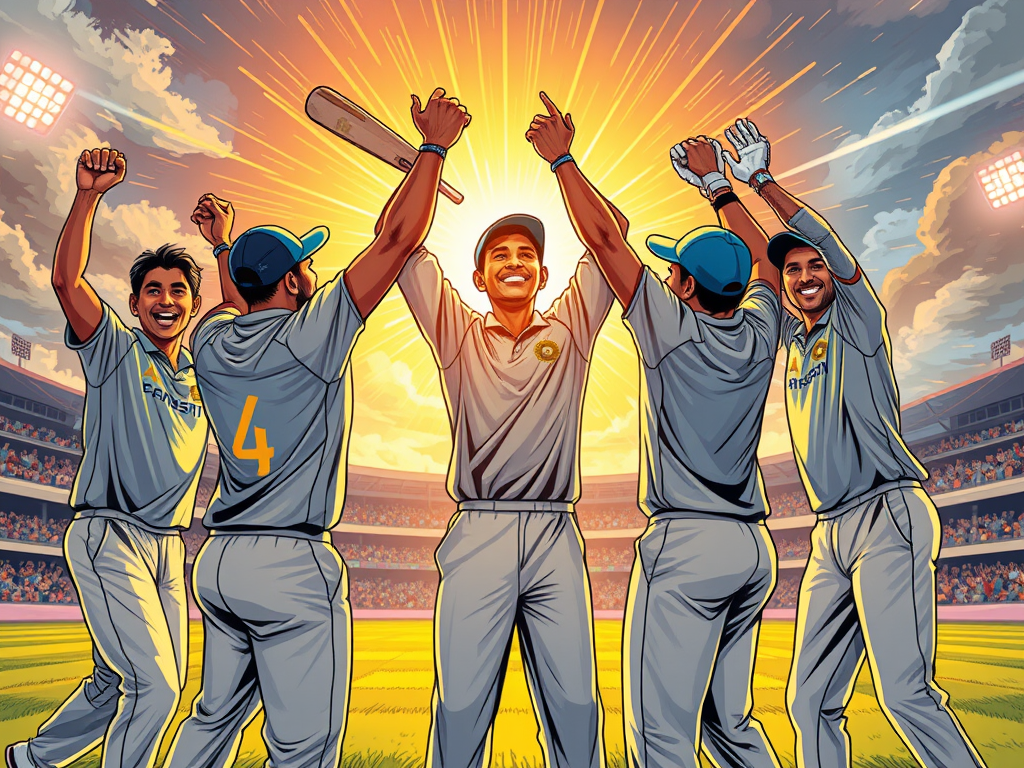
Winning the championship this time felt almost inevitable. The juggernaut took time to gather pace and even stumbled briefly during the Super Eight stage. But once it hit its straps, it mowed down everything in its path. From the outside, the wheels seemed to roll forward with ruthless efficiency. Yet the parts were human—an ensemble of frailty and triumph.
Sanju Samson
When he knelt down, letting the helmet and bat tumble away as he raised his hands, it felt as though the cricketing gods had finally anointed him. Not long ago, he had been down and out, resigned to a fate shaped by a string of low scores and a place out of favour. But fate had other plans. The loss to South Africa, Rinku Singh’s family emergency, and the virtual knockout matches that followed revealed a Sanju-shaped void in the batting lineup.
No one had ever crossed 80+ scores in three consecutive knockout matches on the way to a championship. Riding the vagaries of T20 batting, he unfurled a series of sublime shots, his face carrying an almost spiritual calm. The believers finally exhaled when the prophecy was fulfilled.
Hardik Pandya
Hardik is a champion who has tasted glory many times. Like a trapeze artist, he searches constantly for that perfect arc where time and space align—leaving the audience gasping as he pulls off feats reserved for supreme athletes. It could be a blazing drive through the V, a hard-length ball that traps a marauding batter, or a lightning throw from the boundary to end a charge.
Yet the final reminded everyone that glory is also a conspiracy of time and space. Without that divine alignment, Hardik too is mortal. No matter how fiercely he chased it, the arc would not appear. But Hardik will never stop chasing.
Ishan Kishan
When Ishan first burst onto the scene, he startled everyone with audacious shots and manic hitting, trying to score as much as mathematically possible. Pessimists dismissed it as desperate thrashing that would not last—and it did not.
What followed defined him. He accepted exile gracefully and returned to the wilderness of domestic cricket. There he flailed, but with purpose, carrying his provincial team all the way to the championship. His swivel-pulls, launched from the remotest corners of the country, sent the non-believers out of the cricketing orbit – seeing is believing, and we saw it match after match.
Jasprit Bumrah
Bumrah carries a three-dimensional pitch-map in his mind. His run-up is short and unconventional, but by the time he releases the ball, he has processed a million mental models—like a data scientist narrowing probabilities—to arrive at the most likely mode of dismissal. Bowling becomes an art born of applied artificial intelligence, whenever the fragile body allows him. Against such precision, a batter’s power and instinct rarely stand a chance.
Axar Patel
Axar is the one who quietly picks up everyone’s slack—the wise, self-effacing elder brother who appears whenever the family needs help. When things settle, he slips back into the background, ensuring everything stays in order.
The impossible catches, the teased-out wickets, the runs conjured when others had failed—each act was simply about the team’s wellbeing. No rancour. He has your back.
The Captain
SKY made his reputation in the most fickle format of the game. For some time now, the 360-degree strokeplay has not flowed as freely as it once did. Yet he adjusted, moving himself around so others could flourish.
He seized the important moments and guided the team with quiet assurance. In the end, his legacy may not lie in the shots he played, but in a general’s belief and unwavering loyalty to his troops, even for the beleaguered Abhishek and Varun caught in the cauldron.
It may have looked like the machine that rolled forward with ruthless efficiency. But the wheels moved only because of the frailties, faith and stubborn will of the men who turned them.
If you doubt it, ask Sanju. Ask Abhishek.


