Author: Rajesh Rajamohan

  • Invisible Cities

    Invisible Cities

    Italo Calvino’s Invisible Cities is a skinny book that condenses the experience and idea of living and feeling cities in abstract and manifest ways. It has been a prized possession since I was a student even though I read it a long time ago and still read random chapters. I got hooked by the matter-of-fact, almost parable-like but incisive visions set ablaze in each chapter of the book, which unveils a different city as narrated in an imaginary conversation between Kublai Khan, the Tatar emperor, and Marco Polo, the traveler. Marco talks about the cities with such great tangents and flourish, leaving you gasping at the delightful insights.

    The lyrical narrative of cities is replete with symbolisms and metaphors. These serve as the readers’ devices to begin their treatises on reality and fiction, memory and desire, and past and present. Calvino masterfully writes about the limitation of communication and power, ephemeral but universal cycles of urban living among the ruins and glory of concrete columns, cities as projections of human psyche, and the possibility of whims and greed as cogent sources of creativity. You could try and ponder over Calvino’s dispatches from the book on some of the real cities and their architects – the tunnel cities in China, Berlin, Turkey and those under Gaza and South Lebanon, Ghost city of Pripyat, Ukraine, and Fake cities in North Korea.

    Calvino belongs to the OULIPO(Ouvroir de Littérature Potentielle – Workshop of Potential Literature), a group of writers, logicians, and mathematicians whose primary objective is the systematic and formal innovation of constraints in the production and adaptation of literature (they also define themselves as rats who themselves build the labyrinth from which they will try to escape). The Oulipo believe that all literature is governed by constraints, be it a sonnet, a detective novel, or anything else. By formulating new constraints, the Oulipo is thus contributing to creating new forms of literature.

    Calvino’s fictional cities delve into the mind of each city that you and I have known or could have known from our personal view of the immediate outside world. The personal account of your life could exactly sound like someone else’. Or the kind of experience and people that you met at the first job that you had done in the city would sound agonizingly similar to someone else if you shift the time a little bit. There must always be someone who fought your fights, cried your cries, dreamt your dreams, and lived your life in some city that you think you lived and known for a lifetime.

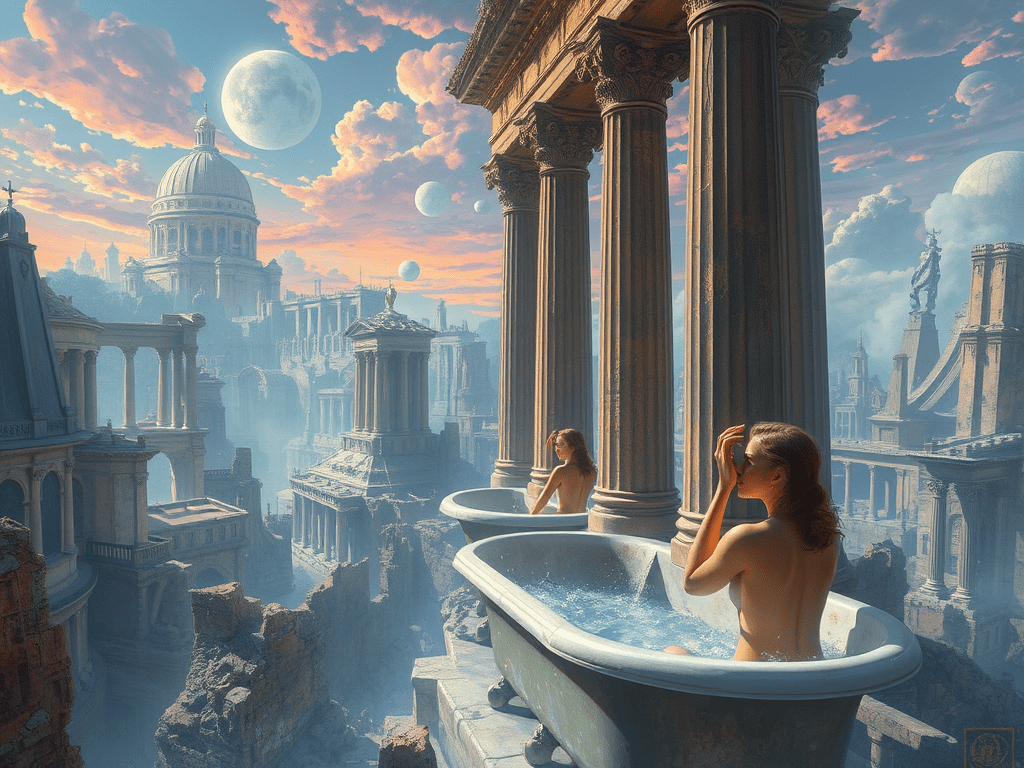
    For example, the invisible City of “Armilla has weathered earthquakes, catastrophes, corroded by termites, once deserted and re-inhabited. It cannot be called deserted since you are likely to glimpse a young woman, or many young women, slender, not tall of stature, luxuriating in the bathtubs or arching their backs under the showers suspended in the void, washing or drying or perfuming themselves, or combing their long hair at a mirror.”

    —If on arriving at Trude I had not read the city’s name written in big letters, I would have thought I was landing at the same airport from which I had taken off. . . . “You can resume your flight whenever you like,” they said to me, “but you will arrive at another Trude, absolutely the same, detail by detail. The world is covered by a sole Trude which does not begin and does not end. Only the name of the airport changes.”

    “Eutropia (a “trading city”) is made up of many cities, all but one of them empty, and its inhabitants periodically tire of their lives, their spouses, their work, and then move en masse to the next city, where they will have new mates, new houses, new jobs, new views from their windows, new friends, pastimes, and subjects of gossip. We learn further that, in spite of all this moving, nothing changes since, although different people are doing them, the same jobs are being done and, though new people are talking, the same things are being gossiped about.”

    From their conversations which began with signs and sounds unintelligible to both, to perfecting each other’s language, to the numbness of understanding through silence, Marco Polo the traveler and Kublai Khan the Emperor have sailed through a lot of cities. Kublai asked Marco: “You, who go about exploring and who see signs, can tell me toward which of these futures the favoring winds are driving us.” Already the Great Khan was leafing through his atlas, over the maps of the cities that menace in nightmares and maledictions: Enoch, Babylong, Yahooland, Butua, Brave New World.

    He continued: “It is all useless, if the last landing place can only be the infernal city, and it is there that, in ever-narrowing circles, the current is drawing us. “And Polo said: “The inferno of the living is not something that will be; if there is one, it is what is already here, the inferno where we live every day, that we form by being together. There are two ways to escape suffering it. The first is easy for many: accept the inferno and become so part of it that you can no longer see it. The second is risky and demands constant vigilance and apprehension: seek and learn to recognize who and what, amid the inferno, are not inferno, then make them endure, give them space.”

    I have had my fair share of cities. You leave a part of you every time you move on to a new destination, hoping you will find what you think you need! eventually, you might visit these cities at some point, hoping again to relive the life and time for a moment with a sense of detachment. Looking back I can see the trail I trod from the walkways in Cochin to Bangalore where the job hunters’ hopes, despair, and celebrations with friends were drenched in rum, to the long and sweltering bus trips to work in Chennai, to Chicago where everyone read something in the commuter trains and Fridays were an onslaught of adrenaline, to New York where you find countless people and cars travel all around you and yet you can listen to the tireless voice of a subway singer with his violin, to the laid back life in small town Pennsylvania and now in this aged, withering city of Philadelphia.


  • Backyard Brawls

    Backyard Brawls

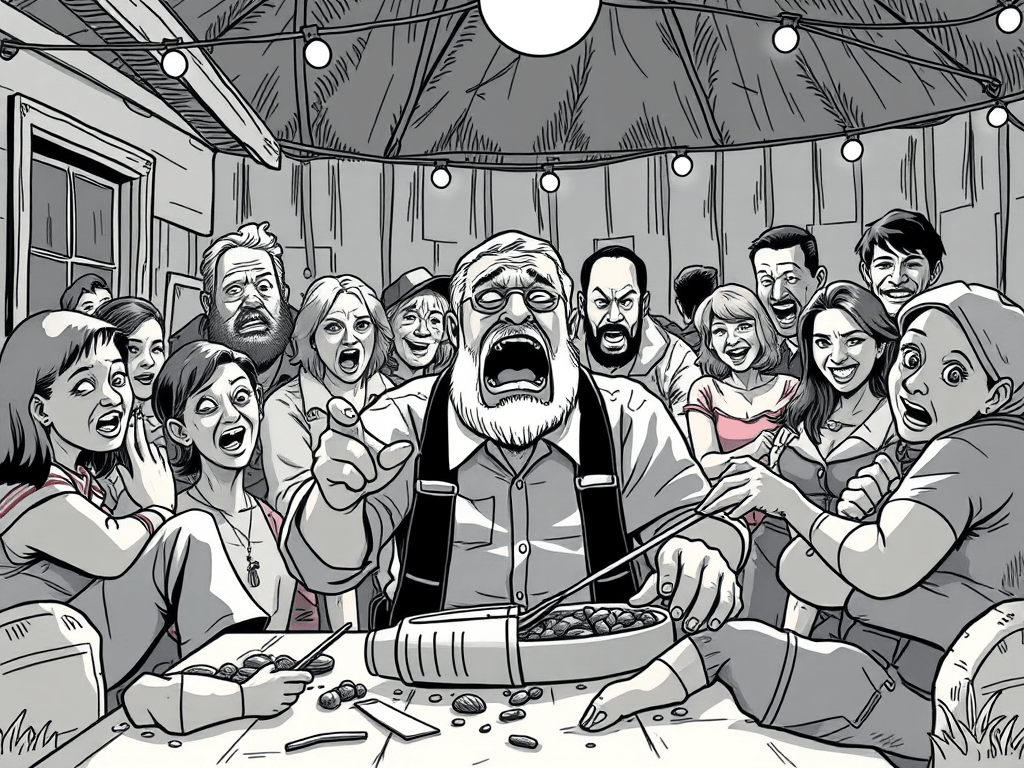
    Imagine a backyard in a small town lost in Appalachia, where uncles, cousins, and friends from the neighborhood gather for Thanksgiving—or some other inopportune occasion. One of them—an uncle, tipsy and loud—starts ranting about a long-forgotten feud. A certain family member, he insists, isn’t grateful enough for his life or the family. He must be taught a lesson—now, and how! Thus, the customary brawl breaks out, ending as always: with one or two shotguns fired in random directions, a volley of aimless verbal violence, and a mess of broken furniture.

    The ever-present mix of helplessness, poverty, and alcoholism—practically a permanent disability in town—seeps into people’s minds, corroding whatever remains of reason. Violence lurks in every corner, waiting for the slightest spark. Even those lucky enough to escape the gravitational pull of that world are never entirely free. J.D. Vance, against all odds, defied gravity—and found himself in the house of unlimited power.

    Zelensky had spent years fighting an existential battle against a hard, dour, and ruthless dictator with limitless resources. But none of that prepared him for dinner at the Oval House, hosted by JD. As soon as the guest in army uniform took his seat, JD saw the setting morph into the familiar gray backyard from Appalachia where Uncle Trump needed a nudge and a reminder of how things ought to be done. It shouldn’t matter that JD and Rubio voted against the help for which Zelensky wasn’t “thankful enough”. The ungrateful visitor must be verbally put in his place. He should thank his stars that the brawl ended with just the denial of dinner and a summary send-off, not a sentence or broken bones.

    Unfortunately, the Ukrainians could have done little to avoid invasion and outlast the medieval brute. Cowering before a dictator, ruing his misfortune ever since his tanks began exploding on the road to Kyiv—doesn’t inspire awe or respect. Enemies of democracy couldn’t believe their luck, while the rest stood paralyzed—too worried and confused to predict an uncertain future.

    In their misguided zeal to cling to power, Democrats, liberals, and traditional Republicans ignored the crumbling foundation of freedom and decency. By allowing illiberal and aberrant elements to take center stage, they paved the way for dysfunctional folks from the backyard to seize the house of power.

  • Radcliff’s Mission

    Radcliff’s Mission

    In the early years after 1970, Dominique LA Pierre and Larry Collins interviewed many high-ranking officials while researching for their book about events about Indian independence and partition – Freedom At Midnight. Of all the veterans eager to share their stories about the imperial adventure and the end of the Empire, only one showed reluctance. Cyril Radcliffe, the last Viscount of Radcliffe was a 45-year-old lawyer practicing at the Chancery bar and was appointed a King’s Counsel in 1935.

    As part of the Indian Independence Act, passed in the Parliament of the United Kingdom, two boundary committees were set up. The mission was to partition British India into two independent dominions – India and Pakistan. Radcliffe hardly knew anything about India and never set foot beyond Paris when Lore Chancellor (Mountbatten) called upon him to chair the committees. He had to draw the borders of two (three in future) nations within five weeks. Even God had only seven days to accomplish much more than that. Nehru and Jinnah preferred the provenance of ignorant, cold impartiality over their respective discoveries of secular and holy lands.

    Dominique LA Pierre visited the last Viscount of Radcliffe in a former convent attached to the ruins of a Gothic Church in Warwickshire. He was pruning rose bushes in the yard armed with clippers. He had a cold reserved air about him “that hardly invited confidences”. He recalled it was precisely his inexperience in the matters of India, according to the Lord Chancellor that qualified him for the job. After the meeting with the Chancellor, a high official came to India’s office and unfolded a map to show him the provinces he would have to divide. LA Pierre asked him, “Could you have refused?”

    “I knew vaguely that they were both in the north of the country, one in the west and the other in the east. I watched the officer’s fingers run along the Indus River, skim the barrier of the Himalayas, go down to New Delhi, climb back up towards the Ganges, skirt the shores of the Gulf of Bengal… The sight of the two vast regions I was going to have to cut in half gave me vertigo.”

    Sir Cyril arrived in New Delhi a few days later in the sultry heat after the meeting. He began to trace on a Royal Engineers map the boundary lines separating two huge populations who used to be subjects of the Empire. He had no contact with them and had no agency or wisdom to foresee the grand march of devastation he was to unleash upon them.

    “I knew water is a symbol of life everywhere – that whoever controls the water controls life. And there I was having to carve irrigation channels. Canal systems, locks, and reservoirs on a map, I mutilated rice and corn fields without ever having seen them. I have not visited a single village through which my boundary would pass, nor form any idea of the tragedy it would inflict upon poor peasants suddenly deprived of their fields, wells, and routes. The maps provided were inadequate and had wrong information that Punjab’s five rivers flowed several miles away from where they were officially surveyed. The demographics statistics too were falsified by both parties to support their claims.”

    Of the two provinces, Bengal gave the least trouble. Once Calcutta was determined based on the Hindu population, the rest was easy – “My boundary was just a pencil line drawn on a piece of paper. In the tangle of marshes and half-flooded plains of Bengal, there were no natural boundaries to serve as a frontier.” And Punjab? The mere mention of the name was enough to make the barrister’s eyes pucker. He said as he mopped his forehead, “The whole area was a mosaic of religious communities overlapping one another. It was impossible to delimit the boundary that would respect the integrity of the communities. I had to cut to the quick.”

    “I knew from the outset that a bloodbath would follow the publication of my plan for partition”, he sadly admitted as he recalled the memory of the torrid heat of those summer weeks and their cruel, enervating dampness in the three rooms of a Bungalow under a fan suspended from the ceiling stirring up a swirl of papers that were pieces of maps, reports and notes with rice glue behind them coming unstuck from the walls as if it was a symbolic storm portending the epic tragedy that awaited the villages of Punjab.

    Annotated from “Freedom At Midnight”, Larry Collins and Dominique La Pierre

  • Pakistani States of Mind

    Pakistani States of Mind

    Picking up the pieces after the pause on Operation Sindoor is daunting, considering the high stakes Modi raised on Pakistan and India.

    The War

    For starters, a match-up or “notch up” of conventional warfare under the shadow of a nuclear disaster is an uneasy prospect, when the blowback will not stop at the border. The flight and downing of jets and exchange of projectiles were quality tests on leased Chinese weaponry and India’s assorted line-up of arms bought from the West, made-in-India variety, and some Russian, with an Indian recipe. The missiles targeted at India are named after the marauding medieval invaders from Central Asia and Turkey. India’s sudden acceptance of the call for ceasefire from Pakistan raises the question: Did they achieve their strategic goals, or is it a mere pause until the next attack by motivated terrorists? People living precarious lives along the border will tell us that war is no fun.

    The General in His Labyrinth

    The Pakistani General announced his firm belief in the two-nation theory just days before the brutal murder of innocent tourists from many states of mainland India by terrorists. He is undeterred by the sum of all failures thus far — the breaking away of Eastern Pakistan, the troubles in Baluchistan, a broken social fabric, and a failing economy, acknowledged safe haven for global terrorists. The only thing that stood between his army and the ultimate defeat of “infidels” was not having enough faith in the promise of their one God. He is a Hafiz who can recite the Quran to believe his messianic role in God’s call for Jihad upon infidels. Pakistani Generals are colorful Marquezian tin pot dictators with God as the alter ego with the smarts to find patrons for an endless supply of money and deadly weapons.

    Terrorist

    Terrorists are eternal opportunists. The plotters constantly observe, take notes, and plan the next raid. The poor, simple-minded expendables from the hinterlands of Punjab and tribal areas hide in plain sight in the company of motivated locals, clutching on to satellite phones until they receive the order to strike. They descend from the shadows after the holy month to perform their scripture-ordained duty to eliminate non-believers. The converted believers from the subcontinent owe it to their new faith to reconquer the land of Hind with a sword or bullet, for a place in paradise. They spared the lives of widows and daughters of the men they killed, as it was important for the killers to send a message of their merciful God and a warning to the leader of non-believers. The response was the retribution on behalf of the wronged women of a secular India. The Indian Army spokeswoman, Sophia Qureshi ironically wasn’t speaking on behalf of the lost tribe of Qureshi-s who lost the battle of Badr as written in the terrorists’ holy book.

    Chinese Quest

    China, in its bloody minded quest for silk routes, believes that its technology, often stolen from the West, and boundless production units can ride it’s fortune while the medieval wildlings are busy killing their brothers of old belief for now. The path to glory, a greater China, they believe, requires Islamic rage as fuel for human bombs to unleash on the inferior nations with minimum or no cost, while keeping the industrial-scale extermination and sometimes regeneration of deviants in Tibet and Xinjiang in a Han image. When finally the religious wars are over, the clashing armies will have annihilated each other to herald the greatest Chinese empire. This is not a dystopian dream if you consider the Chinese intent for granting nuclear technology to Pakistan. After all, some pieces of a disintegrated India with Chinese names are already in the official documents written in Mandarin, giving away hints of an impatient Chinese mind.

    The West

    Joseph Conrad’s sons in the West, in their infinite wisdom to civilize the dark continents, now want to prevent a holocaust among thoughtless, violent, and emotionally unbalanced brown people. Pakistan, as a gun for hire, is much cheaper than the Wagner brothers, with better training and the zeal of the faithful. If you doubt, just ask the Soviets. Why would they let it perish for the sake of the revival of Hindutva — pagans dreaming of hegemony. Empathizing and legitimizing their plight and grievances are the last things on their minds, whether liberal or conservative. The scatter-brained leader of the free world can only confuse the struggle as a thousand-year backyard brawl in which the prodigal son keeps returning with convictions of a new faith, who is convinced of the ultimate triumph, will always end up making the Dharmic elder look bad!!

    Colonial State

    Pakistan is the idea of renaissance men haunted by colonial nostalgia. It is the Muslim version of Old India, where you find the progeny of feudal Zamindars and merchants with old money from Central India, Punjabi bureaucrats and men in uniform from British India, and the poor but fanatically faithful migrants from the mainland like Uttar Pradesh and Bihar. The feudal lords became the political class, diplomats and bureaucrats, and servicemen turned into business conglomerates moonlighting as the military, and the peasants filled madrasas that became recruiting centers for the Lashkars. Everybody else migrated to the West with their bounty or hopped onto a dhow to the Middle East for menial jobs or even to beg.

    Indian State

    The Idea of India is mankind’s longest project. Kashmir, with a majority of citizens believing in Islam, is not an anomaly. There are a million Kashmirs — big and small — all across India, thriving in a democracy, however chaotic, that is growing economically and technologically while struggling with their identity to find a place in it, and some even moving past the debate to believe in the identity as Indian in a democracy trumping the rest. The Congress Party, which led the non-violent resistance for freedom, made a Faustian bargain with the medieval-minded section of minority for power. The right-wing BJP is living on the edge to retain it.

    The cacophony

    The world has become a babel! There is a no-holds-barred scrap in the corporate and social media pushing narratives. While in Pakistan, even the liberal commenters have gone nuclear, turning into Army spokesmen and competing with Jehadis for bluster. Neutral commentators, trapped in nostalgia, replay tired narratives like old VHS tapes. Truth dies when war begins.